This simulation is ideal for business schools, executive education programmes, corporate training for management and governance teams, HR learning & development, and boards seeking to deepen their understanding of incentive alignment and agency risk.

Incentives and Agency Conflict Simulation
Balance ethical and beneficial decisions in the Incentives and Agency Conflict Simulation. Navigate trade-offs, incentive structures and potential conflicts inherent to real life when interests collide.

Incentives and Agency Conflict Simulation Overview
This immersive simulation enables participants to assume roles across a spectrum of stakeholder relationships (boards and executives, investors and fund managers, or owners and management teams) and to navigate how incentives, information asymmetry and organisational design shape behaviour.
Through sequential rounds, participants confront scenarios such as bonus schemes, risk-taking incentives, monitoring and control mechanisms, and the tensions that arise when agents pursue their own interests rather than the principal’s.
Much like other advanced simulations in finance, M&A or investment banking, this one encourages decision-making under uncertainty, stakeholder pressure and evolving performance metrics. Participants will make strategic decisions, respond to the behaviour of other parties, and reflect on how incentive design and governance affect outcomes.

Incentives and Agency Conflict Simulation Concepts
Participants work through realistic scenarios, which can be customized to emphasize or exclude specific topics depending on the learning goals. This modular structure allows the simulation to be tailored to any type of session. Key concepts include:
- Principal–agent relationship
- Incentive alignment vs. misalignment
- Information asymmetry
- Agency cost
- Monitoring and control mechanisms
- Risk-taking and moral hazard
- Reward systems and behavioural effects
- Governance and contract design
- Stakeholder dynamics
- Decision-making under uncertainty

Gameflow
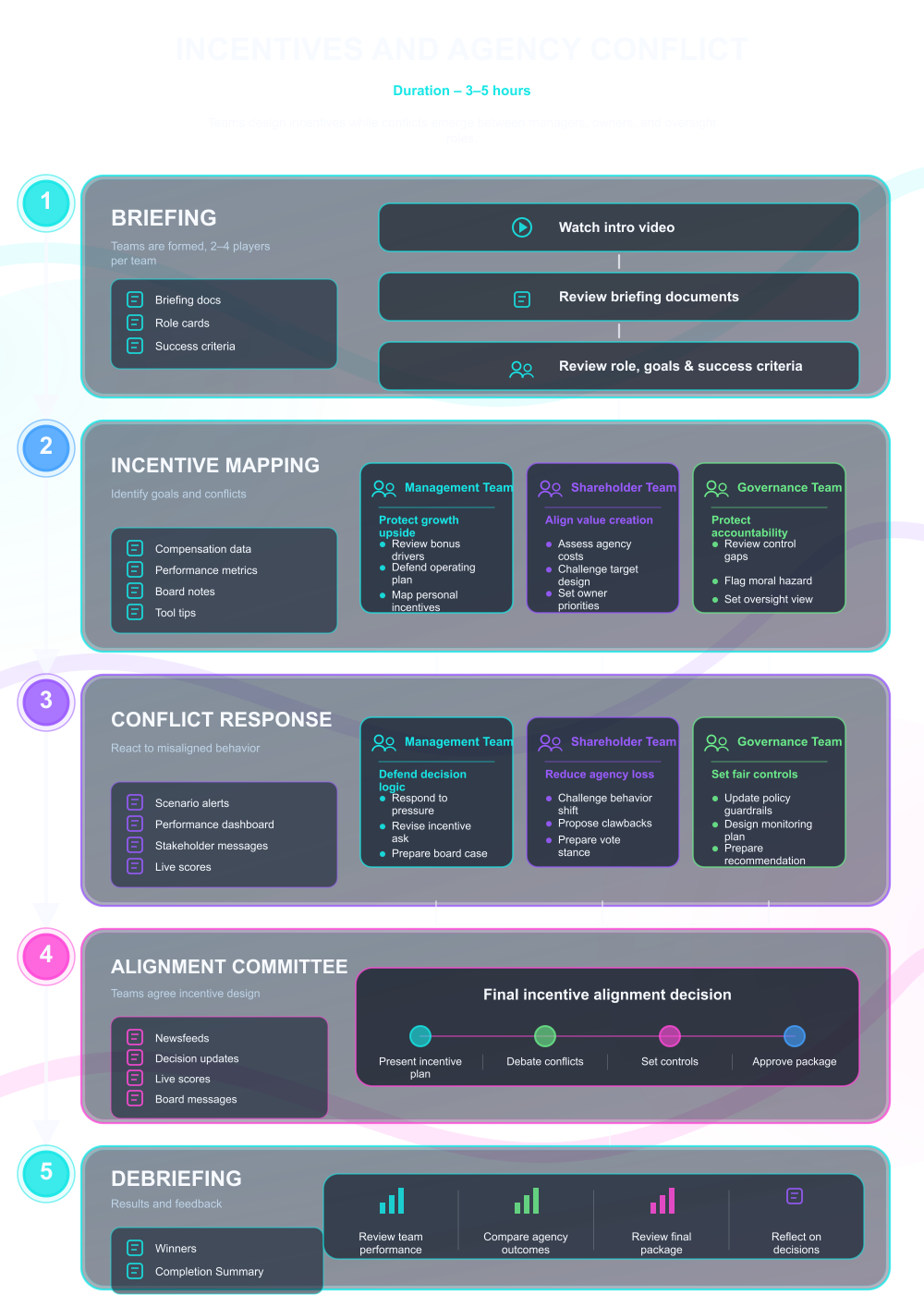

What Participants Do
In the simulation, participants will:
- Review organisational context, contract terms, historical performance, risk profile, stakeholder expectations
- Make strategic operational decisions, choosing how much risk to take
- Negotiate contract amendments, monitoring intensity or disclosure policies
- Make deals while being presented with tasks that push for personal gain or in principal’s best interest
- Design incentive schemes, choose performance metrics, reward timings, monitoring frameworks and governance structures
- Navigate the push and pull of different power dynamics between principals and agents

Learning Objectives
By the end of the simulation, participants will be able to:
- Understand the principal–agent framework and why agency conflicts arise.
- Recognise how incentive design and reward structures can drive agent behaviour.
- Analyse the impact of information asymmetry and monitoring limitations on organisational performance.
- Evaluate different contract and governance mechanisms for aligning agent and principal interests.
- Make decisions about risk-taking, reporting, transparency and stakeholder trade-offs in an agency context.
- Communicate effectively between principals and agents, negotiate contract terms and adjust governance frameworks.
- Develop a mindset of designing incentives not just for performance, but for alignment, accountability and long-term value creation.
How the Incentives and Agency Conflict Simulation Works
This simulation can be run individually or in teams in academic or corporate contexts.
1. Identify the tasks and stakes Participants receive a scenario background, role descriptions (principal, agent, board, auditor), tasks contract terms and organisational context.
2. Tasks Execution Agents propose operational plans, risk levels and request incentive schemes; principals (or boards) evaluate proposals, design contract/incentive packages, set monitoring protocols.
3. Strategy adjustments Agents may alter strategy, principals/boards may amend incentive structure or tighten oversight.
4. Outcome & Performance Metrics The simulation calculates outcomes (return on investment, risk exposure, etc) and presents them to participants. Agents may use different metrics to present those outcomes to principals.
5. Present to the Principals Agents present their decisions, defend their rationale all while principals assess the outcomes.
6. Review and Reflect Feedback highlights participants’ flexibility, ability to communicate clearly, and strategic thinking under the pressure.
Frequently Asked Questions
Assessment
To evaluate participant learning and performance, the simulation includes an assessment component which can be tailored to educational or corporate environments. Typical assessment criteria include:
- Ability to design incentive schemes that align agent behaviour with principal objectives.
- Appropriate oversight, reporting and control mechanisms given the risk profile and scenario context
- Effectively in deploying strategies, make risk-reward trade-offs, and adapt to events?
- The abikity to alignt agent' actions with principal interests
- Negotiating contract terms, communicating with stakeholders and managing divergent interests
- Participants may evaluate their own and peers’ performance on collaboration, leadership, negotiation and decision-making behaviours.