It's ideal for MBA students, finance graduates, aspiring traders, and corporate treasury professionals seeking practical, hands-on experience in currency derivatives and risk management.

FX Options Simulation
In this FX Options Simulation, participants become currency derivatives traders: managing portfolios, and responding to volatility while balancing risk, reward, and real-time market dynamics in the global foreign exchange marketplace.

FX Options Simulation Overview
Participants step into the role of FX options traders and risk managers navigating dynamic currency markets. Each trading round introduces new challenges—central bank announcements, geopolitical events, economic data releases, volatility spikes, and shifting correlations between currency pairs.
They must analyze market conditions, structure appropriate options strategies, manage the unique risks of options (including delta, gamma, vega, and theta), and make critical decisions on hedging, speculation, and position sizing.
This simulation is ideal for university finance programs, trading floor preparation courses, and corporate treasury training. It brings the fast-paced world of FX derivatives to life, demonstrating how theoretical pricing models interact with real-world liquidity, market sentiment, and risk limits.

FX Options Simulation Concepts
Participants work through realistic scenarios, which can be customized to emphasize or exclude specific topics depending on the learning goals. This modular structure allows the simulation to be tailored to any type of session. Key concepts include:
- FX options pricing fundamentals
- Building strategies: Calls/Puts, Straddles, Strangles, Risk Reversals, Butterfly Spreads
- Volatility trading: Implied vs. Historical Volatility, Volatility Smiles/Skews
- Correlation risk management across currency pairs
- Hedging corporate FX exposure using options
- Portfolio margin and leverage considerations for options
- The impact of interest rate differentials on option valuation
- Exotic options concepts introduction

Gameflow
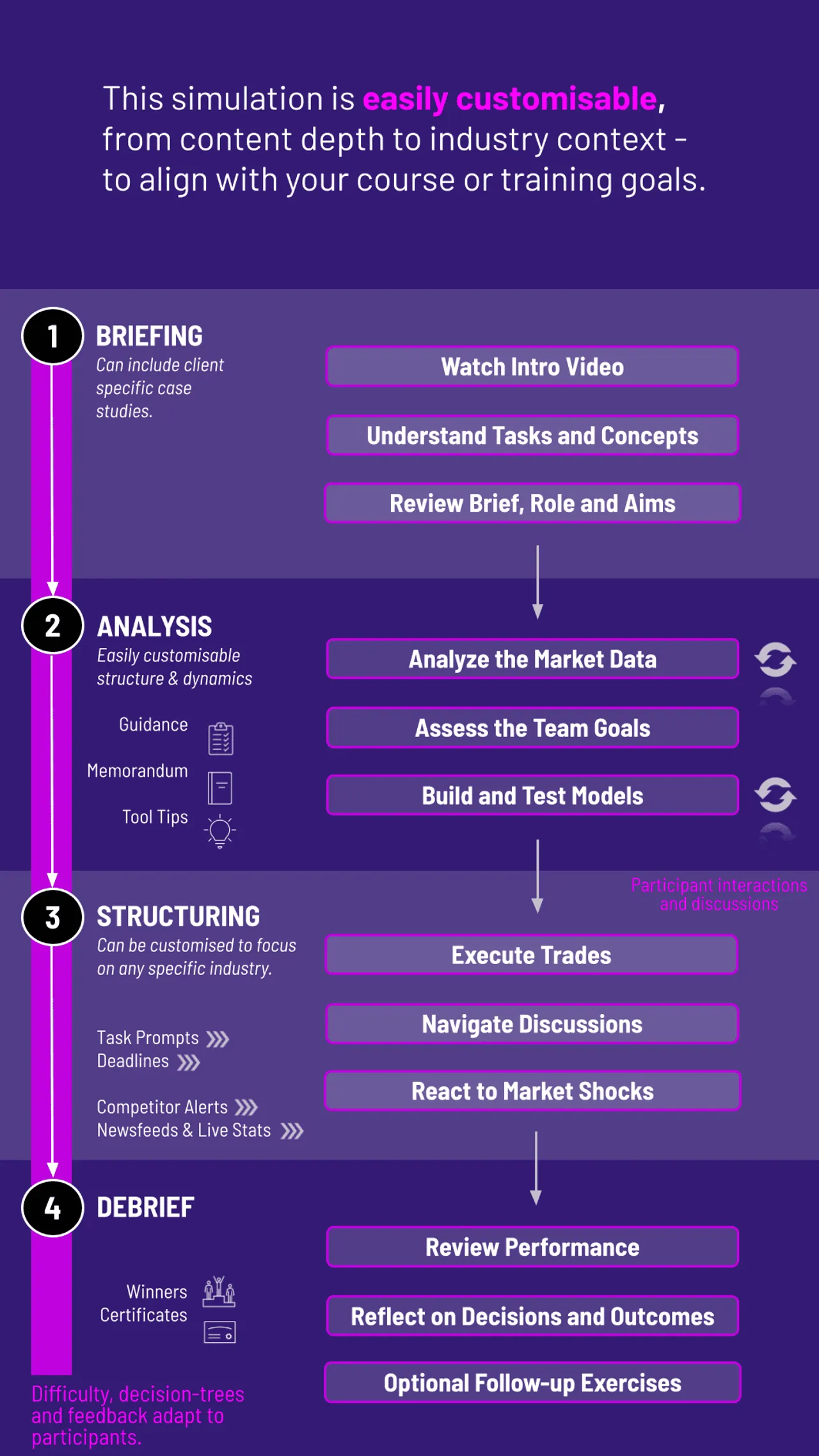

What Participants Do
In the simulation, participants will:
- Analyze live market data and economic calendars to form a view.
- Structure and execute options strategies to express market views or hedge risks.
- Actively manage a portfolio, monitoring and adjusting for the "Greeks."
- Respond to simulated market shocks and volatility events.
- Decide when to cut losses, take profits, or roll positions.
- Justify their trading decisions and risk posture in a daily "floor manager" debrief.

Learning Objectives
By the end of the simulation, participants will be able to:
- Understand the structure, utility, and risks of common FX options strategies.
- Apply options pricing theory and the "Greeks" to real-time portfolio management.
- Construct options-based solutions for hedging and speculative objectives.
- Manage a portfolio's risk exposure under conditions of market stress.
- Interpret volatility data and its critical role in options trading.
- Build confidence in financial decision-making under uncertainty.
How the FX Options Simulation Works
This simulation can be run individually or in teams in academic or corporate contexts. Each cycle represents a stage of getting through a pressing financial situation.
1. Receive Market Brief Participants get a macroeconomic snapshot, client hedging needs, and risk limits.
** 2. Analyze and Plan** Teams analyze spot FX movements, volatility surfaces, and interest rate curves to identify opportunities.
3. Execute and Manage They trade options, build a portfolio, and continuously monitor and adjust their positions.
4. Collaborate Teams debate market views, allocate risk capital, and prepare for the client review.
5. Communicate Outcomes Participants deliver a concise trade rationale and performance summary.
6. Review and Reflect The system provides feedback on P&L, risk-adjusted returns, and Greek exposures. Strategies evolve across multiple rounds
Frequently Asked Questions
Assessment
Assessment of participant performance can be tailored according to the host institution’s objectives (business school, corporate training, assessment centre). Typical assessment criteria include:
- Absolute return, risk-adjusted return, and maximum drawdown.
- Effectiveness and consistency in managing Greek exposures (especially Delta and Vega) within stated limits.
- Appropriate use of options strategies for stated market views or hedging objectives.
- Clarity, logic, and market analysis behind trading decisions during debriefs.
- Ability to adjust strategies effectively in response to simulated market shocks.