It is ideal for university finance programs, MBA students, corporate training for banks and asset managers, and anyone seeking practical experience in securities trading and portfolio management.

Fundamentals of the Capital Markets and Securities Industry Simulation
Our Capital Markets Simulation immerses participants in the role of a securities trading firm, making real-time decisions on trading, risk management, and investment strategy in a dynamic, multi-asset marketplace.

Fundamentals of the Capital Markets and Securities Industry Simulation Overview
The Fundamentals of Capital Markets and Securities Industry Simulation replicates the core engines of the capital markets. Experience the pressure and thrill of the markets firsthand.
Participants, operating in teams as competing trading desks or asset management firms, navigate a live market driven by economic data, news events, and the collective actions of all players. They must analyze information, execute trades across equities, bonds, FX, and derivatives, manage a portfolio, and balance the pursuit of profit against regulatory constraints and market risk.
The simulation moves through multiple economic cycles, testing participants' ability to adapt their strategies under changing conditions. It bridges textbook theory with the unpredictable, behavioral reality of the financial markets.

Fundamentals of the Capital Markets and Securities Industry Simulation Concepts
Participants work through realistic scenarios, which can be customized to emphasize or exclude specific topics depending on the learning goals. This modular structure allows the simulation to be tailored to any type of session. Key concepts include:
- Market Structure and Participants
- Asset Classes: Equities, Fixed Income, FX, Derivatives
- Portfolio Theory and Asset Allocation
- Trading Strategies
- Market and Credit Risk
- Economic Indicators and Their Market Impact
- Securities Regulation and Compliance
- Broker-Dealer Operations
- Order Types and Execution
- Behavioral Finance and Market Sentiment

Gameflow
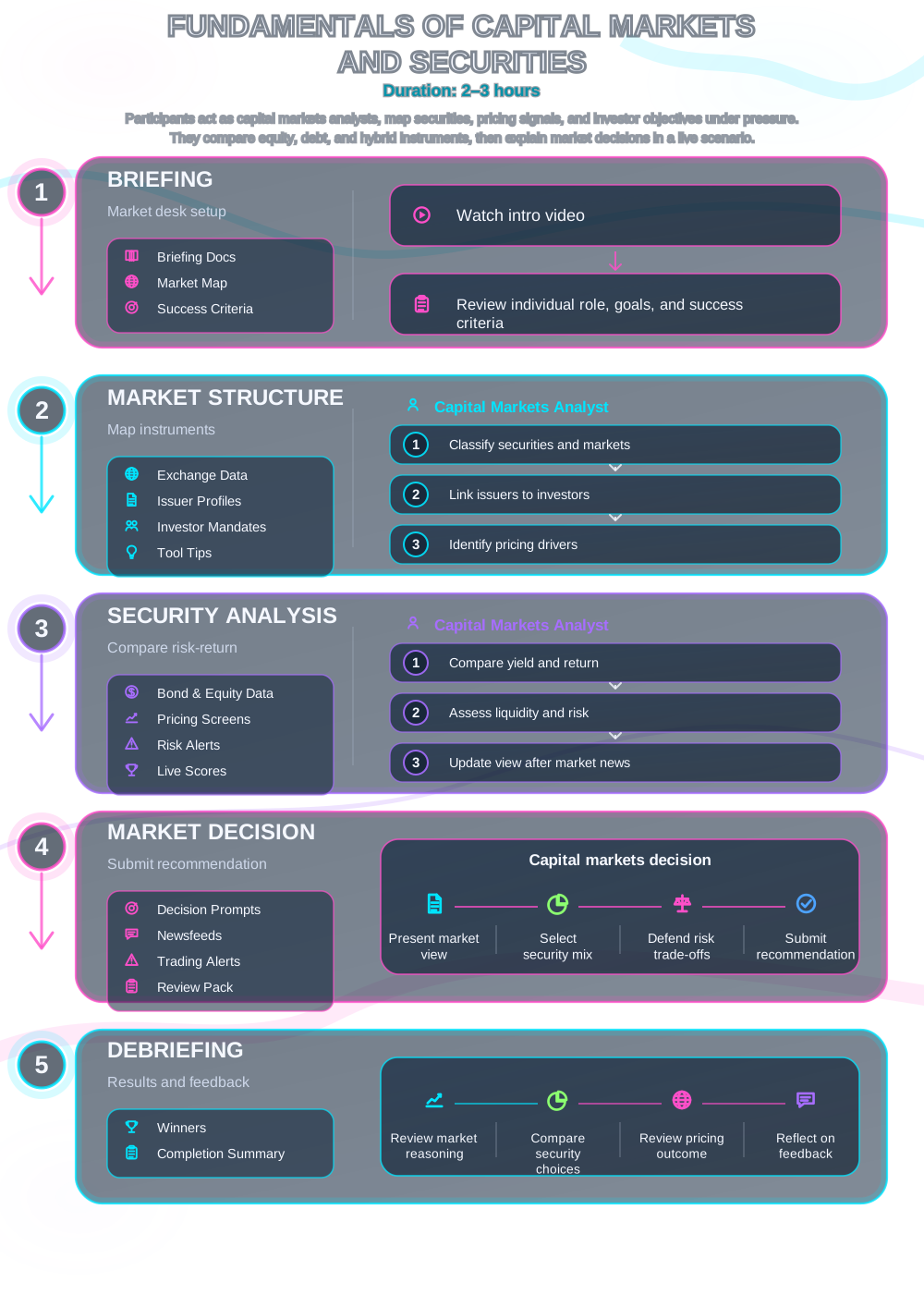

What Participants Do
In the simulation, participants will:
- Create a trading entity, define initial strategy, and allocate capital.
- Interpret live news feeds, economic reports, and price charts.
- Place orders across multiple asset classes on a real-time trading platform.
- Monitor positions, exposure, P&L, and risk metrics, adjusting hedges as needed.
- Respond to simulated central bank announcements, geopolitical shocks, and corporate actions.
- Comply with simulated capital requirements, reporting rules, and trading limits.
- Strive to top the leaderboard based on risk-adjusted returns.
- Defend decisions and performance in a final debrief to "senior management" or "clients."

Learning Objectives
By the end of the simulation, participants will be able to:
- Explain the mechanics and interactions of key capital market segments.
- Construct and justify a multi-asset investment or trading strategy.
- Execute trades and manage a portfolio using professional risk frameworks.
- Quantify and interpret core market risk measures.
- Analyze how macroeconomic events translate into market price movements.
- Evaluate the trade-off between return, risk, and liquidity.
- Function effectively within a team under time pressure and uncertainty.
- Communicate complex financial decisions and results clearly and concisely.
How the Fundamentals of the Capital Markets and Securities Industry Simulation Works
This simulation can be run individually or in teams in academic or corporate contexts. Each cycle represents a stage of getting through a pressing financial situation.
1. Setup Participants are assigned roles within their firms. They receive initial capital, a rulebook, and access to the trading platform and research terminal.
** 2. Market Sessions** The simulation runs over several rounds, each representing a quarter or a year. Each round includes: pre-market analysis, live trading and mid-session shock.
3. Post-Market Review Teams analyze their P&L, risk reports, and adjust strategy for the next round.
4. Debrief and Assessment The simulation concludes with a performance review. Teams present their strategy, results, and lessons learned, connecting their experience to theoretical concepts.
Frequently Asked Questions
Assessment
Assessment of participant performance can be tailored according to the host institution’s objectives (business school, corporate training, assessment centre). Typical assessment criteria include:
- Final Portfolio Value and Absolute Return, Sharpe Ratio, Sortino Ratio, Compliance Score
- Clarity of rationale, adaptation to events, understanding of outcomes.
- Quality of decision-making documentation.
- Peer evaluations and facilitator observations on collaboration, role fulfillment, and contribution to analysis.