It is designed for MBA students, finance graduates, junior analysts, and professionals in commercial banking, asset management, or fintech seeking practical expertise in advanced fixed income markets.

Fixed Income Derivatives Simulation
The Fixed Income Derivatives Simulation immerses participants in the high-stakes arena where institutional investors hedge risk, speculate on macroeconomic shifts, and engineer tailored financial solutions using sophisticated instruments.

Fixed Income Derivatives Simulation Overview
This hands-on simulation places teams in the role of a derivatives trading desk at a major bank or hedge fund. Participants are confronted with a dynamic economic environment where central bank policies, inflation reports, and credit events drive market volatility.
The core challenge is to manage a portfolio of interest rate swaps, options, and credit derivatives while balancing client structuring requests with proprietary trading goals. Teams must interpret the yield curve, calculate sensitivities, and execute strategies to profit from or protect against movements in rates and spreads.
The simulation progresses through multiple rounds, reflecting the passage of time and the arrival of new market data, forcing continuous re-assessment of positions and risk exposure.

Fixed Income Derivatives Simulation Concepts
Participants work through realistic scenarios, which can be customized to emphasize or exclude specific topics depending on the learning goals. This modular structure allows the simulation to be tailored to any type of session. Key concepts include:
- Yield Curve Dynamics and Term Structure Theories
- Pricing and Valuation of Interest Rate Swaps
- Mechanics and Applications of Swaptions, Caps, and Floors
- Credit Default Swaps Pricing and Basis Trading
- Duration, Convexity, and DV01 Risk Management
- Option Greeks in Fixed Income Context
- Collateral and Counterparty Credit Risk
- Structured Products and Client Solutions
- Central Bank Policy Impact on Derivatives Markets

Gameflow
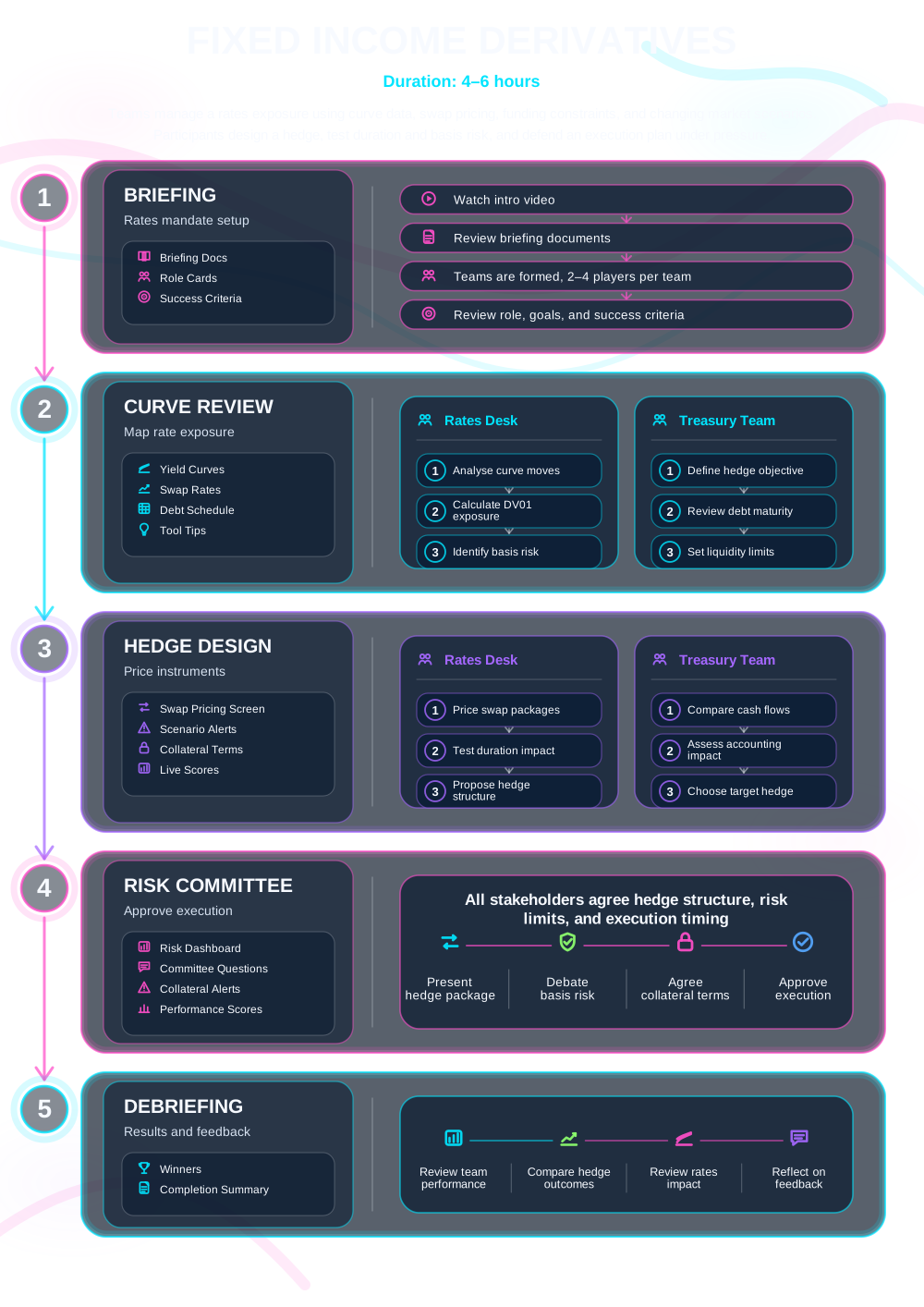

What Participants Do
In the simulation, participants will:
- Interpret live yield curves, volatility surfaces, and economic scenarios.
- Execute trades in swaps, options, and CDS across multiple tenors in a competitive dealer market.
- Actively manage the interest rate and volatility risk of a complex book of derivatives.
- Design and price custom derivative solutions for corporate and institutional client cases.
- Identify and exploit relative value opportunities between cash bonds, futures, and derivatives.
- Justify trading decisions and P&L based on market movements and risk metrics.

Learning Objectives
By the end of the simulation, participants will be able to:
- Articulate the economic purpose and mechanics of key fixed income derivatives.
- Quantify and manage the key risks (interest rate, volatility, credit) of a derivatives portfolio.
- Formulate trading and hedging strategies based on a view on rates, curve shape, or volatility.
- Explain how macroeconomic developments translate into derivatives market prices.
- Evaluate the payoff and risk profile of structured fixed income products.
- Collaborate effectively under pressure to make data-driven financial decisions.
How the Fixed Income Derivatives Simulation Works
This simulation can be run individually or in teams in academic or corporate contexts. Each cycle represents a stage of getting through a pressing financial situation.
1. Team Formation Participants are grouped into competing trading desks.
** 2. Initial Briefing** Teams receive initial capital, a starting book of positions, market data, and client RFPs.
3. Market Rounds The simulation progresses through controlled time periods. Each round features: new economic data/market shocks, trading and hedging windows, client mandates, portfolio revaluation.
4. Debrief and Review Instructors lead a comprehensive review linking market actions, theoretical concepts, and final outcomes.
Frequently Asked Questions
Assessment
Assessment of participant performance can be tailored according to the host institution’s objectives (business school, corporate training, assessment centre). Typical assessment criteria include:
- Final portfolio risk-adjusted return, P&L consistency, and drawdown control.
- Quality of written trade tickets and end-of-simulation desk report, justifying strategies based on market views and risk management principles.
- Accuracy and competitiveness of pricing for structured client mandates.
- Contribution to team analysis, decision-making, and workload.