This simulation is ideal for undergraduate and graduate business students, MBA candidates, new hires in finance and accounting roles, and any professional seeking to solidify their understanding of financial accounting fundamentals.

Financial Statement Preparation Simulation
The Financial Statement Preparation Simulation immerses participants in the core accounting cycle, showcasing the transformation of the raw financial data into the critical reports that drive business decisions.

Financial Statement Preparation Simulation Overview
In today's data-driven world, financial literacy is a non-negotiable skill for any business professional. This simulation provides a dynamic, hands-on environment where participants run the accounting function of a simulated company. Participants will be presented with a series of business events over a simulated fiscal period.
Participants’ task is to record these transactions, make necessary accruals and adjustments, and ultimately prepare a complete set of financial statements: the Income Statement, Balance Sheet, and Statement of Cash Flows. The simulation goes beyond mere preparation, challenging participants to analyze their outputs, understand the story they tell, and see how different accounting treatments can impact key performance metrics.
Although ideal for undergraduate and graduate finance courses, executive training, and corporate finance skill workshops, the simulation is modular and scalable, allowing instructors to vary complexity.

Financial Statement Preparation Simulation Concepts
Participants work through realistic scenarios, which can be customized to emphasize or exclude specific topics depending on the learning goals. This modular structure allows the simulation to be tailored to any type of session. Key concepts include:
- The Accounting Cycle
- Double-Entry Bookkeeping
- Accrual vs. Cash Accounting
- Revenue Recognition and Matching Principles
- Depreciation and Amortization
- Inventory Valuation
- Accounts Receivable and Bad Debt Expense
- Financial Statement Interrelationships
- Working Capital Management
- Financial Ratio Analysis

Gameflow
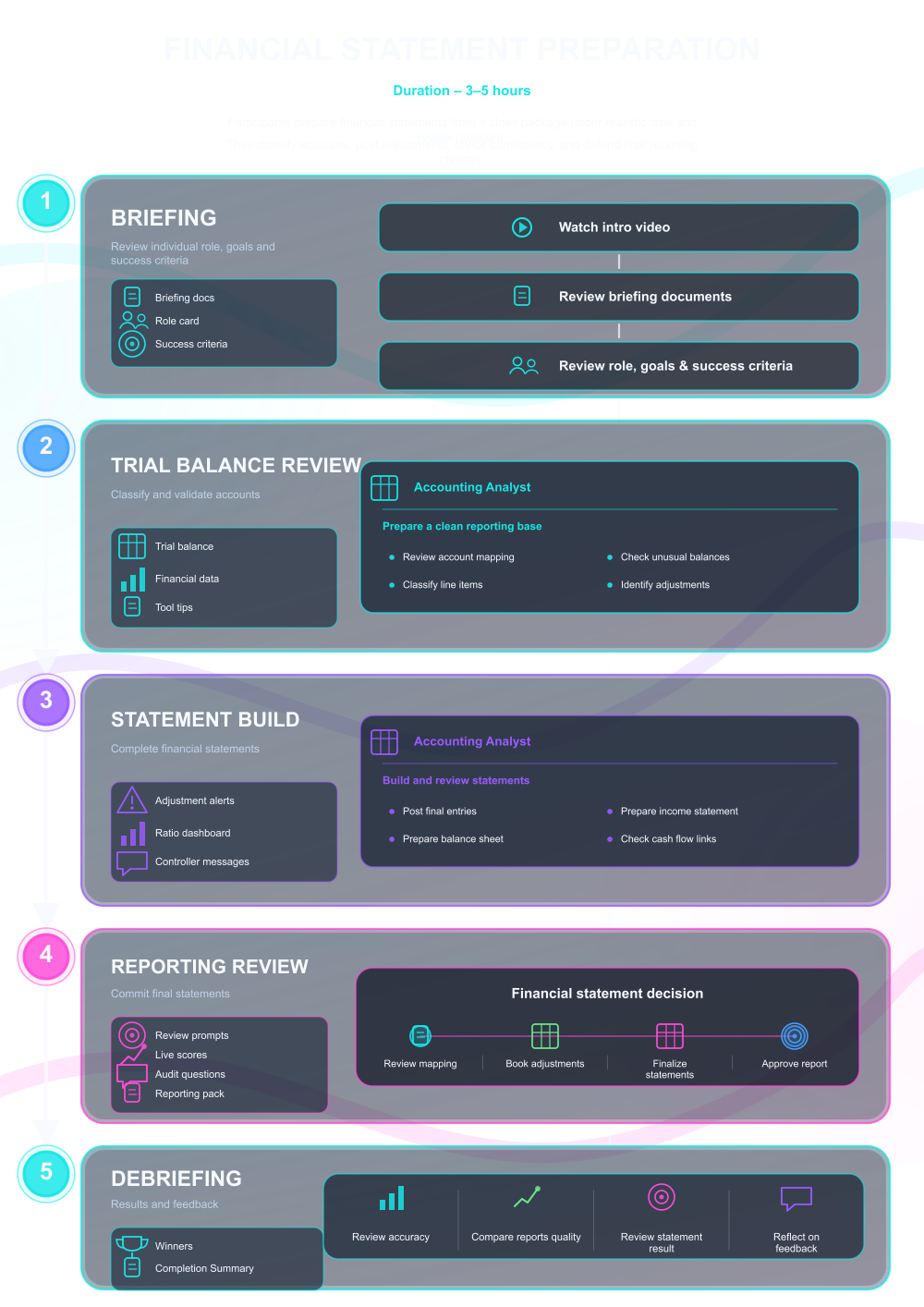

What Participants Do
In the simulation, participants will:
- Record Journal Entries for a wide range of business transactions.
- Post to the General Ledger and prepare an unadjusted trial balance.
- Record Adjusting Entries for accruals, deferrals, and depreciation.
- Prepare a Complete Set of Financial Statements
- Analyze the company's financial health using key performance indicators and ratios.
- Reconcile Net Income with Cash from Operations.
- Make strategic accounting choices and observe their impact.
- Present a summary of the company's financial performance and position.

Learning Objectives
By the end of the simulation, participants will be able to:
- Execute the full accounting cycle from transaction to report.
- Apply GAAP/IFRS principles to record complex business transactions.
- Construct a complete and accurate set of financial statements.
- Analyze financial statements to assess a company's profitability, liquidity, and efficiency.
- Articulate the linkage between the Income Statement, Balance Sheet, and Statement of Cash Flows.
- Evaluate the impact of different accounting policies on financial results.
- Develop the critical thinking skills necessary to diagnose and correct accounting errors.
How the Financial Statement Preparation Simulation Works
This simulation can be run individually or in teams in academic or corporate contexts. Each cycle represents a stage of getting through a pressing financial situation.
1. Introduction and Case Launch Participants are introduced to their company, its industry, and its initial financial position.
2. Transaction Phase A series of business events are presented. Participants must identify the accounts affected and record the appropriate journal entries.
3. Adjustment and Closing Phase At the period-end, participants will make necessary adjusting entries to reflect accrued and deferred items.
4. Statement Preparation Phase Using adjusted trial balance, participants will build the three core financial statements, ensuring they articulate correctly.
5. Analysis and Reporting Phase Participants will calculate financial ratios, interpret the results, and prepare a brief management commentary.
6. Debrief and Feedback The simulation provides instant feedback on participants’ entries and statements. A comprehensive debrief compares their results to model answers, highlighting key learning points.
Frequently Asked Questions
Assessment
Assessment of participant performance can be tailored according to the host institution’s objectives (business school, corporate training, assessment centre). Typical assessment criteria include:
- Quality of the journal entries, ledger postings
- Mathematical accuracy of the prepared financial statements.
- Accuracy at balancing the Net Income flows to the Balance Sheet
- Cash Flows Statement reconciliation with the change in cash.
- Quality of the ratio analysis and the insights provided in the management commentary.