Yes. While a basic understanding of accounting is helpful, the simulation includes intuitive guides, glossaries, and structured decision forms. It is designed to be a learning-by-doing tool for MBA students, executives, and finance professionals alike.

Financial Policy Simulation
An immersive, competitive simulation where participants act as the executive team of a public company, making high-stakes financial policy decisions to maximize shareholder value in a dynamic market.

Financial Policy Simulation Overview
This simulation places teams in the role of senior management at a publicly-traded firm over a compressed multi-year period. Teams must navigate complex trade-offs between debt and equity financing, dividend policy, share buybacks, and strategic investments.
Every decision impacts the company's credit rating, stock price, cost of capital, and overall market valuation. Participants experience firsthand how financial policy is not just a technical exercise but a core strategic function that communicates confidence and strategy to the market, influencing analysts, investors, and competitors. The simulation replicates the pressures of quarterly earnings cycles, activist shareholders, and volatile economic conditions.
Although ideal for undergraduate and graduate finance courses, executive training, and corporate finance skill workshops, the simulation is modular and scalable, allowing instructors to vary complexity.

Financial Policy Simulation Concepts
Participants work through realistic scenarios, which can be customized to emphasize or exclude specific topics depending on the learning goals. This modular structure allows the simulation to be tailored to any type of session. Key concepts include:
- Capital Structure and Leverage
- Cost of Capital
- Dividend Policy and Signaling
- Share Repurchases
- Credit Ratings and Debt Covenants
- Market Valuation Multiples
- Strategic Investment
- Earnings Per Share Management
- Financial Flexibility and Risk
- Shareholder Value Creation

Gameflow
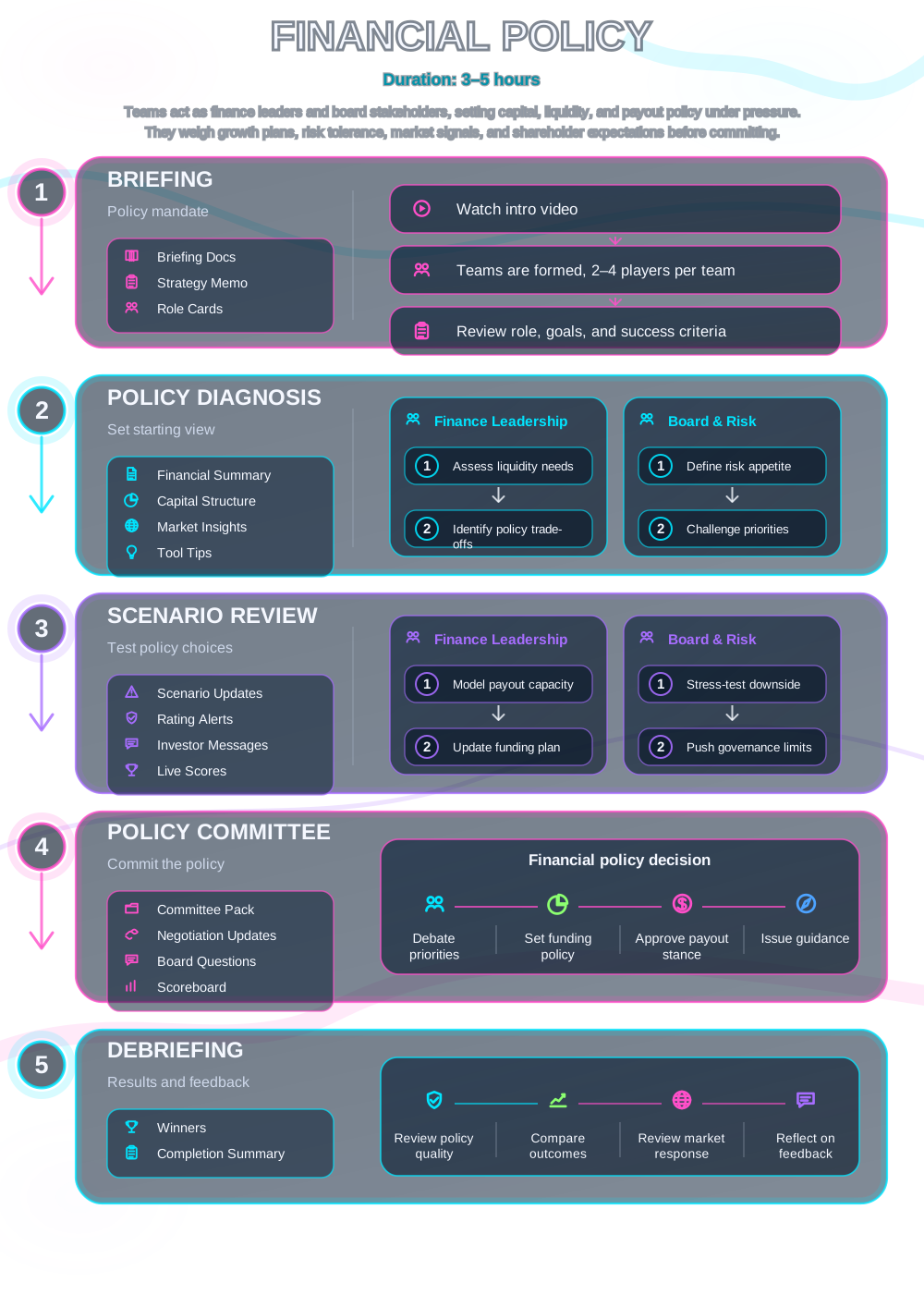

What Participants Do
In the simulation, participants will:
- Analyze financial statements, market data, and analyst reports.
- Issue bonds or equity to fund operations and growth.
- Set dividend levels and execute stock buyback programs.
- Allocate capital to strategic projects.
- Manage the company's credit rating and debt maturity profile.
- Present their financial strategy to a simulated "Board of Directors" or investor audience.
- React to macroeconomic shocks, competitor moves, and activist investor demands.
- Compete for the highest cumulative shareholder return.

Learning Objectives
By the end of the simulation, participants will be able to:
- Articulate the impact of financing decisions on firm value, risk, and financial flexibility.
- Design a coherent financial policy (debt, dividends, buybacks) aligned with corporate strategy.
- Evaluate the trade-offs between different sources of capital and their effect on WACC.
- Understand how credit ratings are determined and how they constrain corporate decisions.
- Interpret how the market reacts to dividend changes, equity issues, and leverage shifts.
- Build integrated financial forecasts to support strategic capital allocation.
- Communicate financial policy decisions effectively to stakeholders.
How the Financial Policy Simulation Works
This simulation can be run individually or in teams in academic or corporate contexts. Each cycle represents a stage of getting through a pressing financial situation.
1. Team Formation Participants are divided into management teams of 3-5, each running an identical simulated company.
2. Initial Analysis Teams review starting financials, market conditions, and analyst expectations.
3. Decision Rounds Each round represents a fiscal quarter. Teams submit integrated decisions on financing, payouts, investments, and guidance.
4. Simulation Engine The simulation algorithm processes all team decisions, modeling market reactions, rating agency responses, and competitive dynamics.
** 5. Results and Analysis** Teams receive detailed reports showing their new financial statements, stock price movement, credit rating, and relative ranking.
** 6. Debrief and Iteration** Facilitators guide analysis of outcomes. Teams adjust strategy for the next round, facing new market scenarios.
** 7. Final Assessment** The simulation culminates with a winner based on Total Shareholder Return and a final strategic review.
Frequently Asked Questions
Assessment
Assessment of participant performance can be tailored according to the host institution’s objectives (business school, corporate training, assessment centre). Typical assessment criteria include:
- A clear, ranked scorecard of primary performance
- Performance across teams, sessions, or against historical data
- Ability to adapt and revise valuations in light of news shocks or changes
- Collaboration, division of work, integration of roles, and final coherence
- Rating by peers and self-reflection on approach and decisions