It is designed for students and professionals seeking practical experience in trading, sales & trading, asset management, and risk management.

Financial Instruments Simulation
In this Financial Instruments Simulation, participants actively price, trade, and hedge across equity, debt, and derivative markets while navigating real-time volatility, news events, and complex regulatory constraints.

Financial Instruments Simulation Overview
The Financial Instruments Simulation is a dynamic, hands-on platform where participants master the core mechanics of modern financial markets by directly engaging with a wide spectrum of instruments. They analyze market data, execute trades, construct diversified portfolios, and manage multifaceted risks in a competitive, multi-player environment that mirrors the pace and pressure of a live trading floor.
Each round introduces new economic data, geopolitical events, and market shocks, forcing participants to adapt their strategies, rebalance holdings, and hedge exposures to protect performance.
This simulation is ideal for university finance courses, MBA programs, and corporate training workshops for analysts and associates. It transforms theoretical knowledge of instruments into practical, decision-making competence, demonstrating how pricing, liquidity, and risk are intrinsically linked in real-world capital markets.

Financial Instruments Simulation Concepts
Participants work through realistic scenarios, which can be customized to emphasize or exclude specific topics depending on the learning goals. This modular structure allows the simulation to be tailored to any type of session. Key concepts include:
- Instrument valuation and pricing fundamentals (bonds, equities, derivatives)
- Yield curves, duration, and convexity in fixed income
- Options pricing (Black-Scholes), Greeks (Delta, Gamma, Vega), and hedging strategies
- Forwards, futures, and swaps mechanics and applications
- Portfolio construction, diversification, and asset allocation
- Market risk, credit risk, and liquidity risk management
- Impact of macroeconomic announcements and central bank policies
- Regulatory frameworks (e.g., Basel III) and capital requirements
- Trading psychology, position sizing, and order types
- Performance attribution and risk-adjusted return metrics (Sharpe Ratio, VaR)

Gameflow
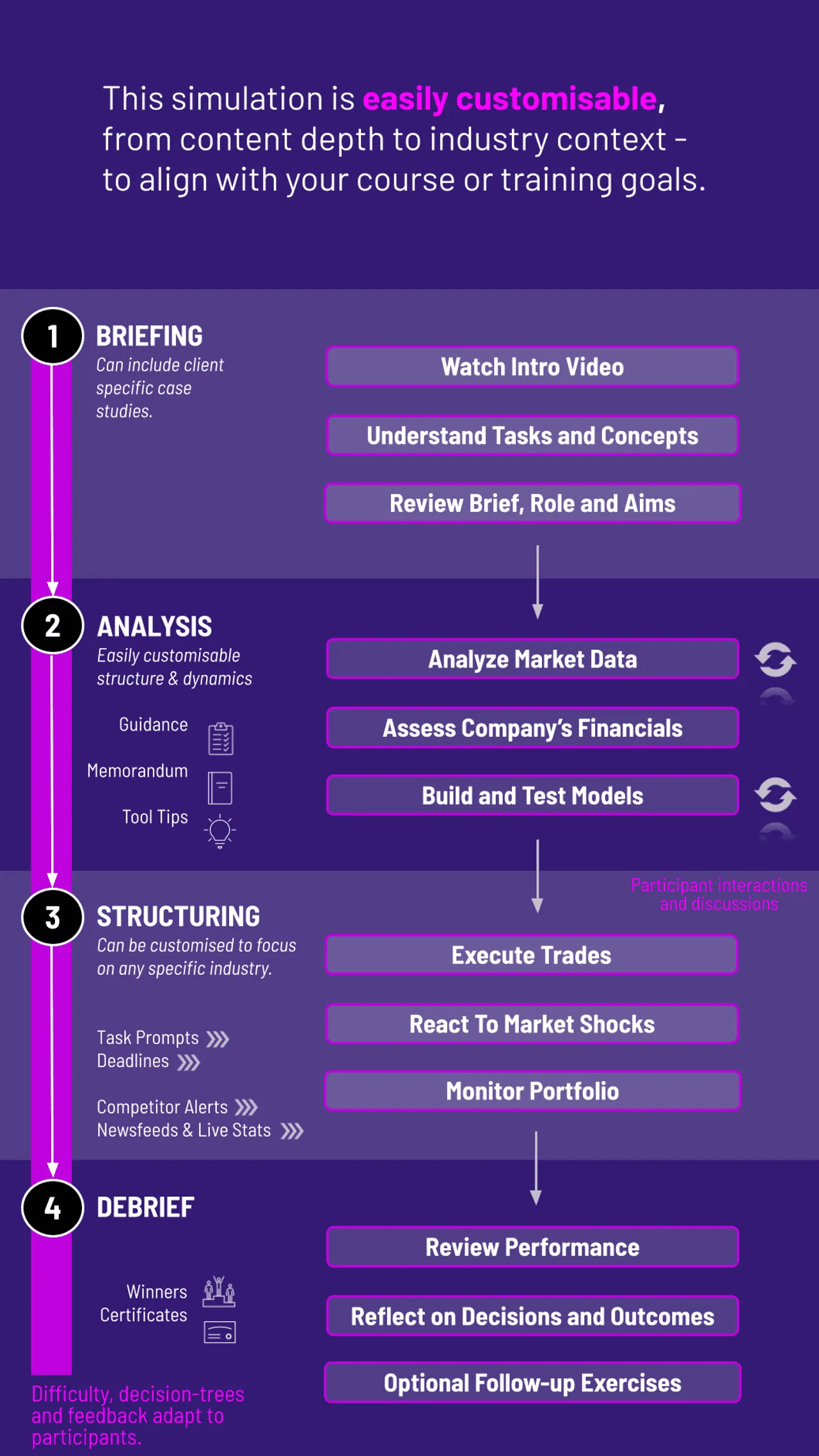

What Participants Do
In the simulation, participants will:
- Analyze live market feeds, economic indicators, and company fundamentals.
- Execute trades across equities, government/corporate bonds, and key derivatives.
- Structure hedging strategies using options and futures to mitigate portfolio risk.
- Manage a multi-asset portfolio, optimizing for return targets within defined risk limits.
- Respond to simulated market shocks, news events, and changes in volatility.
- Present trade rationales and portfolio performance reviews to senior management or clients.
- Reflect on the effectiveness of their trading strategies and risk management decisions.

Learning Objectives
By the end of the simulation, participants will be able to:
- Understand the structure, use case, and pricing mechanics of major financial instruments.
- Apply valuation techniques to equities, fixed-income securities, and basic derivatives.
- Construct and hedge a multi-asset portfolio to achieve specific risk-return objectives.
- Manage market and credit risk exposure using appropriate derivative strategies.
- Interpret the impact of macroeconomic events and monetary policy on different asset classes.
- Execute trades effectively under time pressure and market uncertainty.
- Communicate trading decisions and portfolio performance clearly and concisely.
- Develop confident, practical judgment in financial analysis and trading.
How the Financial Instruments Simulation Works
This simulation can be run individually or in teams in academic or corporate contexts. Each cycle represents a stage of getting through a pressing financial situation.
1. Receive Market Brief Participants are introduced to the economic landscape, their firm's mandate, and initial capital.
** 2. Analyze and Plan** They review real-time data, research reports, and charts to identify opportunities and risks.
3. Execute and Manage Participants place trades, adjust portfolios, and set up hedges. Decisions are input into the simulation.
4. Collaborate and Negotiate Teams may split analyst/trader roles or interact as competing firms in the same market.
5. Face Market Developments New rounds introduce earnings reports, central bank decisions, or geopolitical events requiring swift strategy reassessment.
6. Review and Reflect The simulation generates instant performance analytics (PnL, risk metrics, rankings). Facilitators lead debriefs linking outcomes to decisions.
Frequently Asked Questions
Assessment
Assessment of participant performance can be tailored according to the host institution’s objectives (business school, corporate training, assessment centre). Typical assessment criteria include:
- Absolute returns, risk-adjusted returns (Sharpe Ratio), and maximum drawdown.
- Profit/loss from specific trades, effectiveness of hedging strategies in reducing portfolio risk.
- Adherence to pre-set risk limits (VaR, duration, leverage).
- Quality of support for trading decisions presented in memos or live briefings.
- Effective teamwork and communication within a trading team setting.