A foundational understanding of derivatives (options, futures, swaps) and basic quantitative skills is recommended. The platform includes reference guides and model templates.

Financial Engineering Simulation
The Financial Engineering Simulation uses realistic market data and pricing models, teams design, trade, and hedge sophisticated financial instruments while managing portfolio exposure in real time.

Financial Engineering Simulation Overview
In this simulation, participants step into the role of a financial engineering team at a leading investment bank or hedge fund. They are tasked with creating tailored derivative solutions for clients, executing trades, and dynamically hedging complex risks across multiple market scenarios.
The simulation replicates live market movements, volatility shifts, and counterparty constraints, requiring teams to apply quantitative models, assess Greeks (delta, gamma, vega), and optimize strategies under capital and regulatory limits. Whether pricing exotic options, structuring swaps, or managing a portfolio of tailored derivatives, teams must balance innovation with rigorous risk control.
Although ideal for undergraduate and graduate finance courses, executive training, and corporate finance skill workshops, the simulation is modular and scalable, allowing instructors to vary complexity.

Financial Engineering Simulation Concepts
Participants work through realistic scenarios, which can be customized to emphasize or exclude specific topics depending on the learning goals. This modular structure allows the simulation to be tailored to any type of session. Key concepts include:
- Derivative pricing models
- Option Greeks and dynamic hedging
- Structured product design
- Volatility trading and smile/skew dynamics
- Counterparty credit risk and CVA/DVA adjustments
- Portfolio margin and capital efficiency
- Yield curve modeling and interest rate derivatives
- Stress testing and scenario analysis

Gameflow

What Participants Do
In the simulation, participants will:
- Design and price custom OTC derivatives for simulated client “RFPs”
- Execute trades in a live simulated market with shifting volatilities and rates
- Dynamically rebalance hedges based on real-time Greeks exposure
- Manage P&L and risk limits under changing regulatory conditions
- Structure multi-leg derivatives to meet specific client yield/risk profiles
- Compete in trading rounds that incorporate market shocks and liquidity events
- Present their structured solutions and risk management approach to a simulated “risk committee”

Learning Objectives
By the end of the simulation, participants will be able to:
- Apply derivative pricing theory to live, noisy market conditions
- Develop intuition for managing non-linear risks and tail exposures
- Understand the trade-offs between customized OTC solutions and exchange-traded equivalents
- Improve decision-making under capital constraints and margin requirements
- Enhance ability to communicate complex strategies to clients and risk managers
- Experience the interplay between sales, trading, quants, and risk departments
How the Financial Engineering Simulation Works
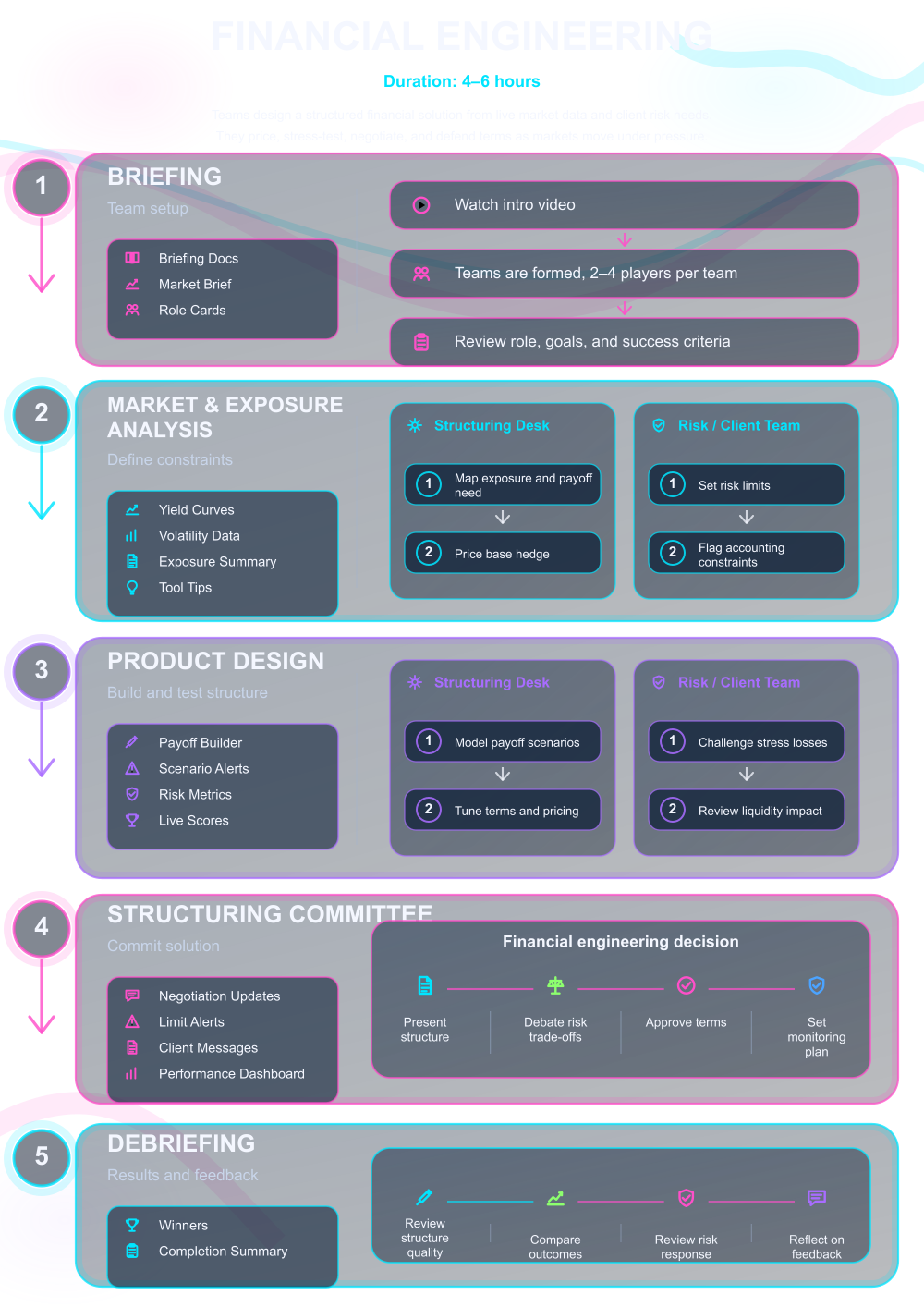
This simulation can be run individually or in teams in academic or corporate contexts. Each cycle represents a stage of getting through a pressing financial situation.
1. Setup Teams receive initial capital, a proprietary book with existing positions, risk limits, and a suite of analytical tools (pricing calculators, risk dashboards).
2. Market and Client Rounds Each round represents a new period: teams analyze incoming market data and client RFPs, they use the platform's tools to design a product, price it, propose a bid/ask spread, and decide if they will warehouse the risk or hedge it instantly in the simulated market.
3. Trading and Hedging Teams enter the simulated market to execute hedge trades, adjust existing positions, or take proprietary views.
4. Risk and Performance Feedback After each round, the platform automatically calculates the team's P&L, updated risk metrics, and collateral calls. Teams see the direct consequences of their engineering choices.
5. Review and Iterate Teams analyze their performance, identify sources of profit/loss, and adjust their strategies for the next round, facing new market shocks and client demands.
6. Final Review The simulation culminates in a management presentation where teams defend their strategy, explain their book's risk profile, and review their overall performance against benchmarks and peers.
Frequently Asked Questions
Assessment
Assessment of participant performance can be tailored according to the host institution’s objectives (business school, corporate training, assessment centre). Typical assessment criteria include:
- Profitability relative to capital used and volatility taken.
- Accuracy and cost of Greek neutralization.
- Innovation in meeting client needs within regulatory limits.
- Adherence to VaR, stress loss limits, and reporting.
- Quality of explanations during risk review meetings.