A basic understanding of financial markets and equity valuation is helpful, but the simulation includes foundational modules on ETF-specific concepts. It is designed to be accessible for advanced undergraduates, MBA students, and professionals seeking to upskill.

ETF Simulation
The ETF Finance Simulation is a dynamic, hands-on learning platform that immerses participants in the fast-paced world of Exchange-Traded Funds. Bridge the gap between textbook theory and the real-world mechanics of constructing, managing.

ETF Simulation Overview
This simulation plunges participants into the role of an ETF Portfolio Manager or a Trading Desk Analyst at a major asset management firm. In a competitive, risk-controlled environment, teams are tasked with launching and managing a suite of ETFs to meet specific market demands and outperform benchmarks.
The simulation covers the entire ETF lifecycle—from initial product ideation and creation/redemption mechanics to liquidity management, tactical trading, and responding to macroeconomic shocks. Unlike static case studies, our platform reacts in real-time to team decisions, mirroring the interconnected nature of global markets.
Participants will grapple with the same strategic, analytical, and operational challenges faced by industry professionals, making it an unparalleled tool for understanding the engine behind passive and smart-beta investing.

ETF Simulation Concepts
Participants work through realistic scenarios, which can be customized to emphasize or exclude specific topics depending on the learning goals. This modular structure allows the simulation to be tailored to any type of session. Key concepts include:
- ETF Structure and Mechanics
- Product Strategy
- Portfolio Construction
- Liquidity and Trading
- Risk Management
- Cost Analysis
- Market Analysis
- Performance Attribution

Gameflow
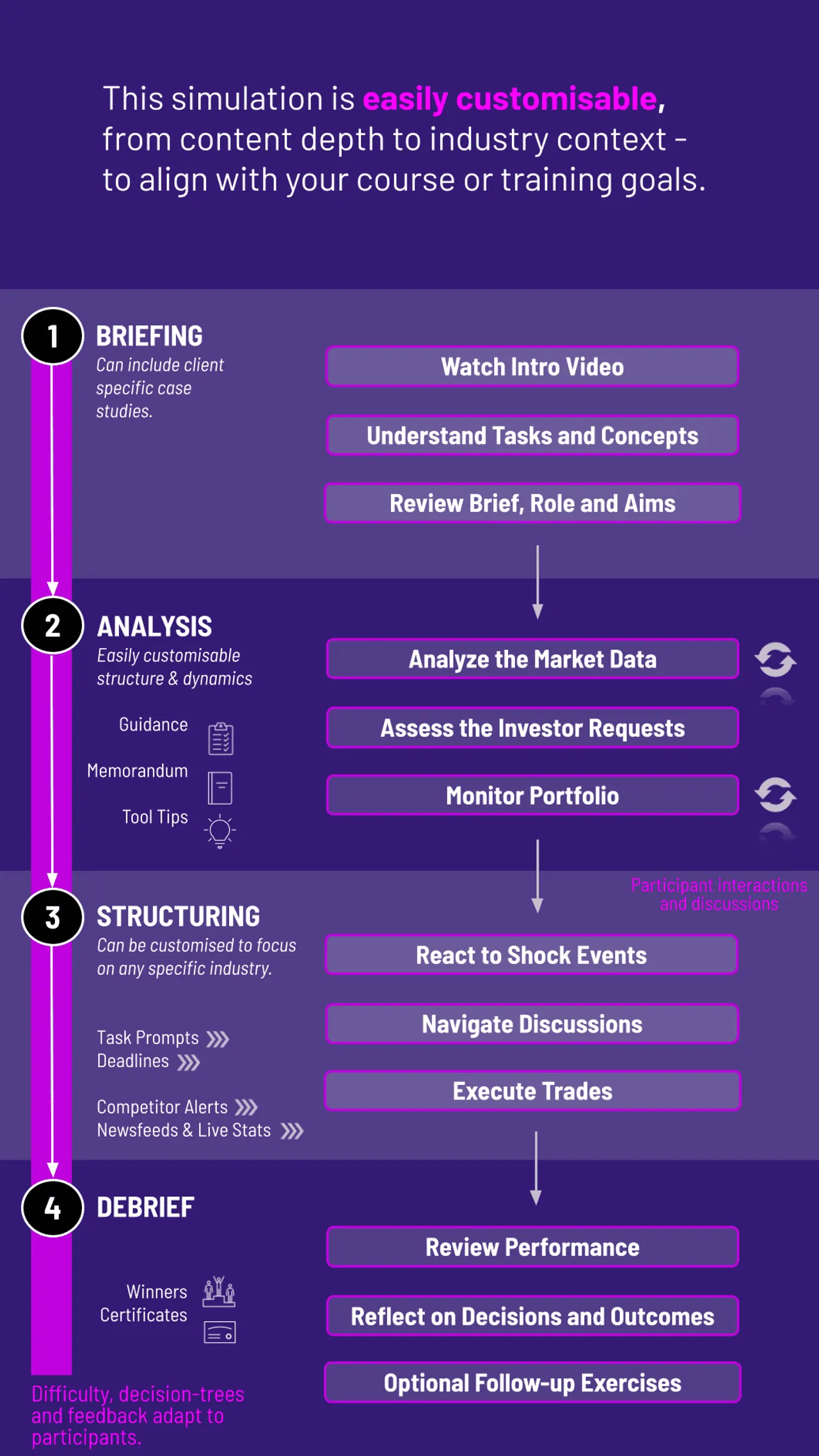

What Participants Do
In the simulation, participants will:
- Choose an index or theme, develop a prospectus, and structure the fund.
- Work through APs to create new ETF shares or redeem them based on market flows.
- Rebalance holdings, optimize for tracking error, and adjust to index changes.
- Collaborate with market makers to manage bid-ask spreads and secondary market depth.
- Monitor rival ETF offerings and adjust strategy for competitive advantage.
- Navigate simulated market volatility, liquidity dry-ups, and regulatory announcements.
- Justify portfolio performance and strategic decisions to a simulated board of directors.

Learning Objectives
By the end of the simulation, participants will be able to:
- Explain the end-to-end operational workflow of an ETF, from creation to trading.
- Design an ETF product strategy aligned with specific investor demographics and market opportunities.
- Construct and manage an ETF portfolio to minimize tracking error and costs.
- Analyze and improve ETF liquidity and trading efficiency in the secondary market.
- Evaluate the performance and risks of an ETF relative to its peers and benchmark.
- Make strategic decisions under pressure, synthesizing financial data and market news.
How the ETF Simulation Works
This simulation can be run individually or in teams in academic or corporate contexts. Each cycle represents a stage of getting through a pressing financial situation.
1. Team Formation Participants are divided into competing ETF management firms.
** 2. Initial Setup and Training** Teams receive capital, access to the simulation platform, and tutorials on the ETF mechanics interface.
3. Rounds of Play The simulation progresses through multiple periods. Each round, teams receive economic and market data, analyze investor flow requests, execute necessary portfolio trades via the primary market, set guidance for secondary market liquidity, review performance reports.
4. Dynamic Scenario Injection The facilitator introduces unexpected events that teams must adapt to.
5. Final Evaluation Teams are assessed on a balanced scorecard including Tracking Error, Total Return vs. Benchmark, Assets Under Management growth, and Liquidity Metrics.
Frequently Asked Questions
Assessment
Assessment of participant performance can be tailored according to the host institution’s objectives (business school, corporate training, assessment centre). Typical assessment criteria include:
- Consistency of portfolio returns vs. the benchmark.
- Management of expense ratios, transaction costs, and tax implications.
- Success in attracting simulated investor flows and maintaining tight bid-ask spreads.
- Sharpe ratio or similar metric for the managed ETF.
- Quality of trade justifications and rebalancing logic documented in team logs.
- Adaptability and rationale in response to injected market scenarios.
- Clarity, depth, and professionalism of the final strategy presentation, including performance attribution analysis and lessons learned.