This simulation is ideally suited for MBA programs, Executive Education courses in Corporate Finance, and training programs for finance professionals, analysts, and corporate treasurers. It is designed for learners seeking practical application of dividend and buyback strategy.

Dividend Policy and Share Repurchases Simulation
Navigate the trade-offs between dividends, buybacks, and reinvestment to maximize firm value and signal strength in a competitive market.

Dividend Policy and Share Repurchases Simulation Overview
This simulation plunges participants into the high-stakes world of corporate capital allocation. A dynamic, hands-on simulation where participants step into the role of corporate CFOs and treasury teams to master one of finance’s most strategic decisions: returning capital to shareholders.
Teams manage a publicly traded company across multiple economic and business cycles, making critical decisions on dividend payments, share repurchase programs, and internal investment. They must balance immediate shareholder expectations with long-term growth, analyze cash flow sustainability, interpret market signals, and react to competitor moves and changing regulatory environments.
The simulation moves beyond textbook theory, emphasizing the real-world impact of these decisions on stock price, investor perception, cost of capital, and corporate control. It replicates the pressure and multifaceted consequences of announcing a dividend cut, launching a massive buyback, or holding excess cash.

Dividend Policy and Share Repurchases Simulation Concepts
Participants work through realistic scenarios, which can be customized to emphasize or exclude specific topics depending on the learning goals. This modular structure allows the simulation to be tailored to any type of session. Key concepts include:
- Dividend Irrelevance Theory vs. Real-World Market Imperfections
- Signalling Theory and Clientele Effects
- Cash Flow Analysis and Payout Sustainability
- Share Repurchase Methods
- Impact on Earnings Per Share and Return on Equity
- Tax Considerations
- Stock Valuation Models in the context of payout policy
- Agency Costs of Free Cash Flow
- Capital Structure Interaction

Gameflow
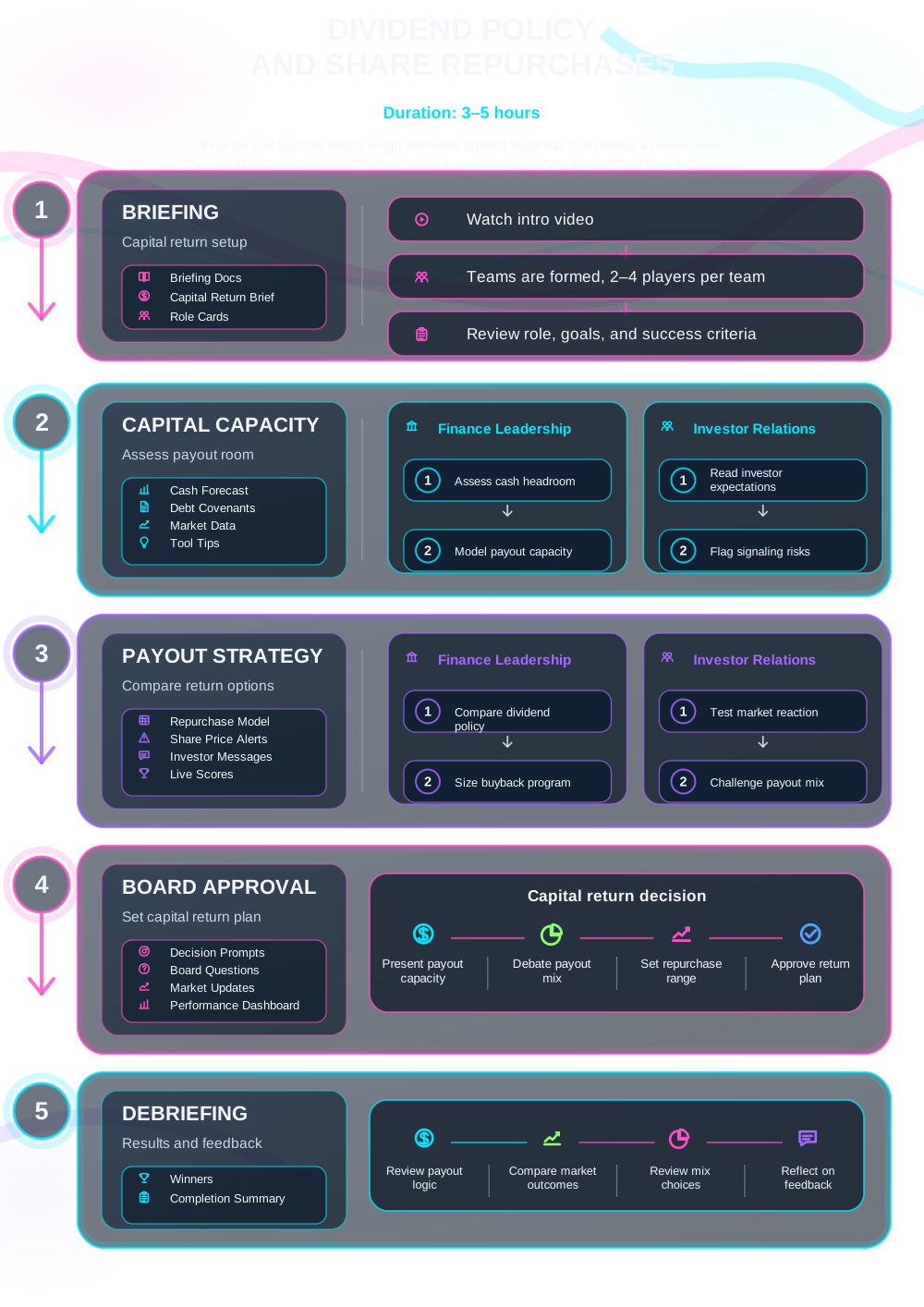

What Participants Do
In the simulation, participants will:
- Assess company cash flows, earnings stability, growth opportunities, and current leverage.
- Decide on a regular dividend, special dividend, or initiate/suspend a share repurchase program.
- Determine the timing and size of open market repurchases or structure a tender offer.
- Craft the communication strategy for each policy change.
- Respond to economic downturns, activist investor pressure, or surprise competitor actions.
- Evaluate stock price reaction, shareholder yield, and relative performance against peer companies in the simulation.

Learning Objectives
By the end of the simulation, participants will be able to:
- Evaluate a company’s financial capacity for shareholder payouts.
- Design a dividend policy aligned with corporate strategy and investor expectations.
- Structure a share repurchase program and understand its mechanical and strategic effects.
- Articulate the market signalling implications of different payout decisions.
- Analyze the trade-offs between returning cash to shareholders and funding internal investments.
- Understand how payout policy interacts with capital structure and cost of capital.
How the Dividend Policy and Share Repurchases Simulation Works
This simulation can be run individually or in teams in academic or corporate contexts. Each cycle represents a stage of getting through a pressing financial situation.
1. Analysis Phase Teams review their performance, cash position, investment pipeline, and market conditions.
2. Decision Phase Teams submit their capital allocation decisions: dividend declarations, repurchase authorizations and amounts, and any strategic communication notes.
3. Simulation Engine Processing The simulation engine calculates the financial and market impact, modeling changes to share count, financial ratios, and investor sentiment.
4. Results and Feedback Teams see their updated stock price, analyst ratings, and shareholder feedback. They review the performance of their decisions relative to peers.
5. Debrief and Learning The instructor facilitates a discussion on the outcomes, connecting team results to core financial principles and best practices.
Frequently Asked Questions
Assessment
Assessment of participant performance can be tailored according to the host institution’s objectives (business school, corporate training, assessment centre). Typical assessment criteria include:
- A composite metric based on stock price appreciation, shareholder return, payout sustainability, and market stability.
- Each team submits a final report defending their chosen policy over the simulation, linking their decisions to financial theory and situational analysis.
- Individual input and collaboration within the team are assessed.
- A brief test on core concepts reinforced by the simulation experience.