Basic understanding of corporate finance concepts such as valuation, financial modeling, and deal structuring is helpful but not mandatory. The simulation includes instructional content for all skill levels.

Divestiture Simulation
Divestiture in Finance Simulation is an immersive and practical training experience where participants step into the role of corporate decision-makers managing the sale or spin-off of a business unit or assets.

Divestiture Simulation Overview
The Divestiture in Finance Simulation replicates the strategic and financial challenges companies face when divesting a non-core division or asset. Participants learn to prepare standalone financials for the unit being divested, build pro forma financial models that forecast impacts on the parent company's valuation and operations, and assess the transaction's effects on shareholder value.
The simulation covers the full divestiture lifecycle—from analyzing the target business segment, modeling its financials independently, to executing the sale and communicating outcomes to stakeholders. It highlights how divestitures can unlock value, improve focus, and reallocate capital effectively.
Customizable scenarios reflect real-world complexities such as regulatory issues, market responses, and negotiation dynamics.

Divestiture Simulation Concepts
Participants work through realistic scenarios, which can be customized to emphasize or exclude specific topics depending on the learning goals. This modular structure allows the simulation to be tailored to any type of session. Key concepts include:
- Definition and strategic rationale of divestitures
- Standalone financial statement preparation for divested units
- Pro forma financial modeling and valuation impact analysis
- Accretion/dilution effects on key financial metrics
- Deal structuring and transaction execution
- Accounting for deconsolidation and reporting changes
- Regulatory, compliance, and market considerations
- Stakeholder communication and investor relations
- Impact of divestitures on corporate focus and financial health

Gameflow
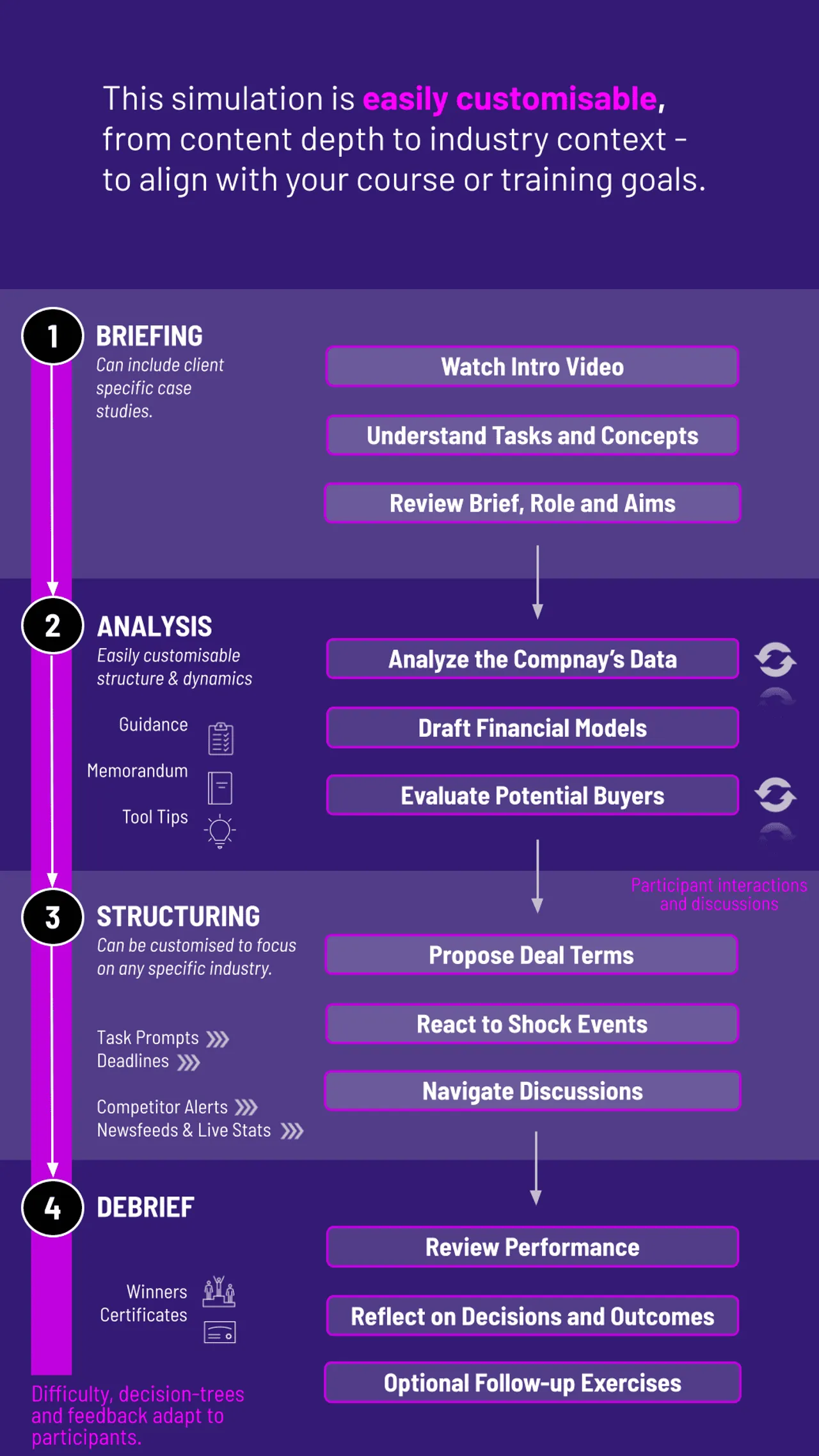

What Participants Do
In the simulation, participants will:
- Analyze financial data and segment business units
- Prepare standalone financial statements for divested entities
- Construct detailed pro forma financial models
- Evaluate potential buyers and transaction structures
- Simulate negotiation and deal closing processes
- Assess post-divestiture impacts on parent company valuation and operations
- Prepare investor updates and internal reports
- Manage regulatory and compliance requirements
- Apply strategic decision-making under uncertainty and market dynamics

Learning Objectives
By the end of the simulation, participants will be able to:
- Understand the strategic and financial implications of divestitures
- Build and interpret standalone and pro forma financial models
- Assess valuation accretion or dilution from divestiture transactions
- Navigate deal structuring, negotiation, and execution processes
- Communicate effectively with stakeholders and investors
- Manage compliance and regulatory challenges during divestitures
- Appreciate the role of divestitures in corporate portfolio management and value creation
- Develop critical thinking and decision-making skills under transaction uncertainty
How the Divestiture Simulation Works
This simulation can be run individually or in teams in academic or corporate contexts. Each cycle represents a stage of getting through a pressing financial situation.
1. Receive Scenario Participants receive a brief outlining the business unit targeted for divestiture along with financial and market data.
2. Analyze the Business Examine segment financials, market positioning, and strategic fit with the parent company.
3. Prepare Financials Separate the divested unit’s revenues, costs, assets, and liabilities to create standalone financial statements.
4. Model Pro Forma Impact Build financial models to project the effects of divestiture on the parent company’s financials and market valuation.
5. Structuring and Negotiation Design deal terms, evaluate buyers, and simulate negotiation scenarios.
6. Execute and Communicate Complete the transaction simulation and prepare performance updates for investors and stakeholders.
7. Review and Reflect Assess outcomes, measure financial and strategic impacts, and refine approaches in successive rounds.
Frequently Asked Questions
Assessment
Assessment of participant performance can be tailored according to the host institution’s objectives (business school, corporate training, assessment centre). Typical assessment criteria include:
- Ability to identify and justify the divestiture target based on strategic fit and long-term corporate goals.
- Proficiency in valuing assets or business units, including modeling accretion/dilution and pro forma financial statements post-divestiture.
- Effectiveness in structuring the divestiture transaction, including deal terms, legal considerations, and negotiation skills.
- Understanding and managing regulatory requirements and compliance issues inherent to divestitures.
- Capability to plan and implement operational and financial independence of the divested entity.
- Evaluation of risks involved in the divestiture and the impact on the remaining business and stakeholders.
- Effectiveness in communicating divestiture rationale, progress, and outcomes to investors, executives, and other stakeholders.
- Responsiveness to evolving market conditions, investor demands, and unforeseen challenges during the divestiture process.
- Ability to work collaboratively in assigned roles reflecting real-world divestiture teams.
- Analytical skills in reviewing divestiture outcomes versus objectives and applying lessons learned
Assessment may incorporate peer and self-review components, facilitator scoring, and debrief discussion. Results may feed into grades, executive feedback, certification or development plans.