Absolutely. It is highly effective for final-year undergraduates in finance, economics, or business, providing crucial practical context for their theoretical studies.

Derivative Securities Simulation
This simulation challenges participants to use futures, options, and swaps to hedge portfolio risk, speculate on market movements, and implement sophisticated trading strategies, transforming theoretical pricing models into actionable financial intuition.

Derivative Securities Simulation Overview
The Derivative Securities Simulation plunges participants into the high-stakes arena of derivative markets. Acting as traders or portfolio managers for a fund, teams are exposed to volatile market conditions, fluctuating interest rates, and corporate events. They must master the leverage and flexibility of derivatives to protect assets, enhance returns, and manage downside risk.
Unlike static case studies, this simulation provides a live market feed, compelling teams to react to news, volatility shifts, and margin calls in real-time. It bridges the gap between Black-Scholes formulas and the tangible pressure of managing a derivatives book, making it an indispensable tool for advanced finance and risk management courses. Navigate the complex world of derivatives in a dynamic, risk-free environment.
Although ideal for undergraduate and graduate finance courses, executive training, and corporate finance skill workshops, the simulation is modular and scalable, allowing instructors to vary complexity.

Derivative Securities Simulation Concepts
Participants work through realistic scenarios, which can be customized to emphasize or exclude specific topics depending on the learning goals. This modular structure allows the simulation to be tailored to any type of session. Key concepts include:
- Pricing and Valuation of Futures, Options, and Swaps
- Delta, Gamma, Vega, and Theta for Risk Management
- Hedging Strategies: Delta-Hedging, Portfolio Insurance
- Speculative Strategies: Straddles, Strangles, Spreads
- Interest Rate and Currency Swaps for Liability Management
- Put-Call Parity and Arbitrage Opportunities
- Margin Requirements and Counterparty Risk
- Volatility Smiles and Market Sentiment

Gameflow

What Participants Do
In the simulation, participants will:
- Execute trades in options, futures, and swaps on various underlying assets.
- Construct and manage a delta-neutral portfolio to hedge against market moves.
- Implement option strategies to capitalize on views on volatility, direction, and time decay.
- Structure interest rate swaps to transform the profile of corporate liabilities.
- Respond to real-time market shocks, earnings announcements, and central bank decisions.
- Monitor and meet margin requirements to avoid liquidation.
- Analyze profit/loss drivers and risk exposure through dynamic dashboards.
- Present a final strategy report justifying their risk-return positioning.

Learning Objectives
By the end of the simulation, participants will be able to:
- Apply theoretical pricing models to live, noisy market data.
- Design effective hedging strategies to mitigate specific financial risks.
- Evaluate the risk-return profile of complex derivative positions using the Greeks.
- Synthesize market information to form actionable views and trade accordingly.
- Manage the operational and financial risks (leverage, margin) inherent in derivative trading.
- Articulate the economic rationale behind trading and hedging decisions.
How the Derivative Securities Simulation Works
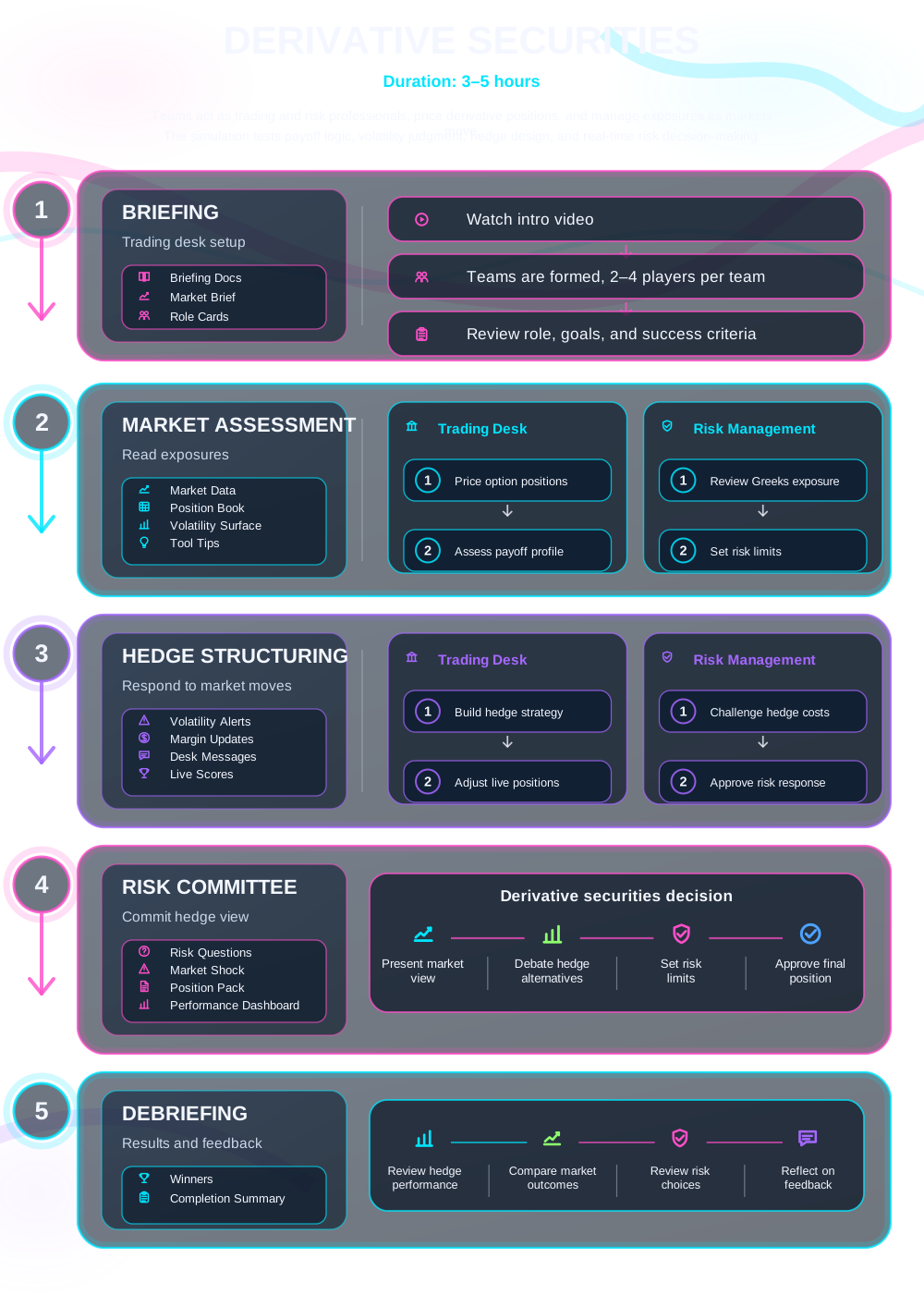
This simulation can be run individually or in teams in academic or corporate contexts. Each cycle represents a stage of getting through a pressing financial situation.
1. Team Formation Participants are divided into competing trading desks or fund teams.
2. Market Introduction Teams receive initial capital, a mandate, and access to the trading platform.
3. Live Trading Rounds The simulation progresses through multiple periods. Each round features new market data, volatility updates, and potential "news events".
4. Strategy Execution Teams analyze data, price derivatives, place orders, and manage their existing book of positions.
5. Performance Feedback After each round, teams see their P&L, risk metrics, and ranking on a leaderboard.
6. Final Review The simulation culminates in a debrief where teams explain their strategy, results, and lessons learned from their trades and risk management choices.
Frequently Asked Questions
Assessment
Assessment of participant performance can be tailored according to the host institution’s objectives (business school, corporate training, assessment centre). Typical assessment criteria include:
- Risk-adjusted returns, accuracy of derivative pricing, effectiveness of hedges (reduction in portfolio volatility/drawdown).
- Quality of trade justifications, consistency with stated market views, and adaptation to new information.
- Proactive management of the Greeks, adherence to margin rules, and overall book risk control.
- Clarity and insight in the concluding report, demonstrating mastery of the link between theory, strategy, and outcome.