This simulation is ideal for MBA students, finance masters students, early-career professionals in commercial banking, corporate banking, credit risk, fixed income, and private debt.

Credit Risk Modeling Simulation
Master the quantitative and strategic aspects of credit risk in this dynamic, hands-on simulation. Participants build and apply credit models to make real-world lending, pricing, and portfolio decisions under pressure.

Credit Risk Modeling Simulation Overview
In today's volatile financial landscape, accurately assessing and pricing credit risk is the cornerstone of profitability and stability for banks, funds, and corporations. This simulation immerses participants in the role of a Credit Risk Management Team at a commercial bank or investment fund.
Teams are tasked with analyzing potential borrowers, building fundamental and statistical models to assign credit ratings, calculate Probability of Default (PD), Loss Given Default (LGD), and Expected Loss. They must then make strategic decisions on loan pricing, covenant structuring, and portfolio allocation, balancing risk and return in a competitive market.
The simulation evolves through economic cycles, testing the resilience of their models and strategies against unpredictable macroeconomic shocks.

Credit Risk Modeling Simulation Concepts
Participants work through realistic scenarios, which can be customized to emphasize or exclude specific topics depending on the learning goals. This modular structure allows the simulation to be tailored to any type of session. Key concepts include:
- Credit Analysis Fundamentals
- Regulatory Framework
- Quantitative Credit Models
- Credit Derivatives and Mitigation
- Portfolio Risk
- Economic Capital and RAROC
- Stress Testing and Scenario Analysis

Gameflow
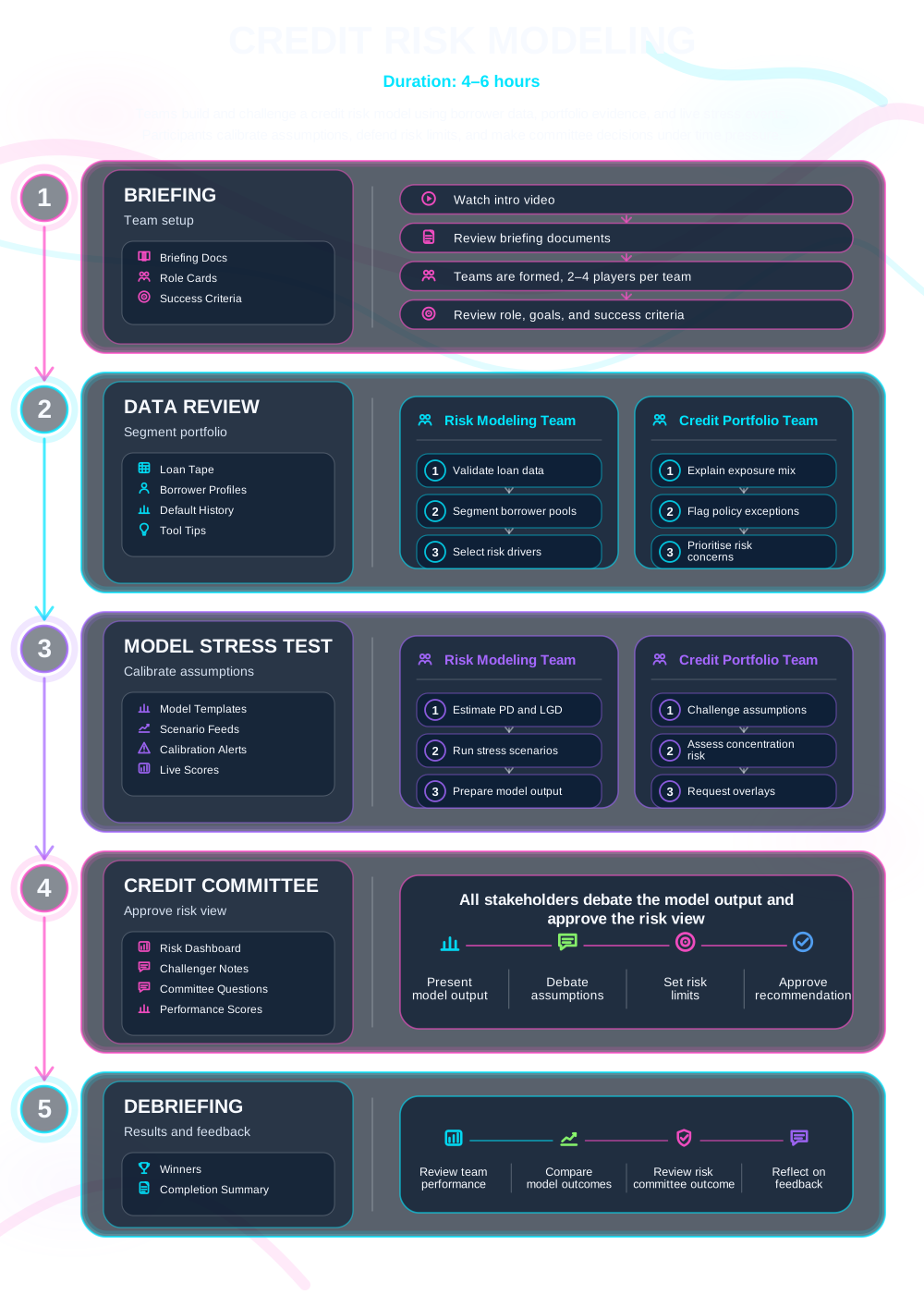

What Participants Do
In the simulation, participants will:
- Analyze detailed financial statements and business models of virtual companies.
- Build a quantitative scoring model to derive internal credit ratings.
- Calculate key risk parameters for individual obligors.
- Price loans and credit facilities, setting interest rate spreads based on risk.
- Negotiate and structure loan terms, including covenants and collateral.
- Construct and manage a diversified loan portfolio.
- Defend their credit decisions and portfolio strategy in a "Credit Committee" review.
- React to economic news and stress scenarios, adjusting their strategy accordingly.

Learning Objectives
By the end of the simulation, participants will be able to:
- Integrate qualitative and quantitative data to form a holistic credit assessment.
- Construct a basic but robust quantitative model to rank and rate credit risk.
- Apply the core regulatory and economic capital concepts to credit decisions.
- Structure and price credit facilities to adequately compensate for risk.
- Understand the trade-offs between risk, return, and capital allocation in a portfolio context.
- Communicate and justify credit decisions effectively to stakeholders.
- Evaluate the impact of macroeconomic changes on credit portfolio performance.
How the Credit Risk Modeling Simulation Works
This simulation can be run individually or in teams in academic or corporate contexts. Each cycle represents a stage of getting through a pressing financial situation.
1. Team Formation Participants are divided into competing credit risk teams.
** 2. Initial Briefing** Receive simulation platform access, economic backdrop, and potential borrower cases.
3. Analysis and Modeling Phase Each round, teams analyze new borrowers, update models with new data, and submit credit decisions.
4. Decision Execution Decisions are processed by the simulation engine. A live "credit market" may allow for buying/selling of credit exposures.
5. Results and Feedback Each round, teams receive detailed performance reports showing portfolio P&L, risk metrics, and unexpected defaults based on the engine's stochastic modeling.
6. Economic Update A new round begins with an evolving economic scenario, forcing teams to re-evaluate their portfolio and strategy.
7. Debrief and Awards The simulation concludes with a comprehensive debrief linking outcomes to decisions, and top-performing teams are recognized.
Frequently Asked Questions
Assessment
Assessment of participant performance can be tailored according to the host institution’s objectives (business school, corporate training, assessment centre). Typical assessment criteria include:
- Quantitative performance is based on final simulation metrics, primarily
- The team's achieved return relative to the economic capital consumed by their portfolio.
- Presentation of the team portfolio strategy and their defence of the key decisions to a panel of instructors.
- Individual contribution to the team's effort, fostering accountability and collaborative learning.