It is designed for finance students (BSc, MSc, MBA), professionals in banking, asset management, or corporate finance, and anyone seeking to understand credit risk analysis from the perspective of a rating agency.

Credit Rating Simulation
In this Credit Rating Simulation, participants must assess corporate creditworthiness, assign accurate ratings, and defend their decisions, all while navigating economic shifts, industry disruptions, and ethical dilemmas in a competitive environment.

Credit Rating Simulation Overview
Participants act as credit analysts responsible for evaluating the financial health and default risk of various companies. Each round presents a new, dynamic corporate case set against a backdrop of changing macroeconomic conditions, industry trends, and market volatility.
They must master the art of financial statement analysis, interpret complex debt covenants, forecast cash flows under uncertainty, and apply official rating methodologies. The simulation captures the high-stakes reality where a single rating decision can impact a company’s cost of capital, investor confidence, and market stability.
This simulation is ideal for university finance programs, corporate training for bankers and investors, and executive education, providing deep insight into one of finance’s most influential and scrutinized functions.

Credit Rating Simulation Concepts
Participants work through realistic scenarios, which can be customized to emphasize or exclude specific topics depending on the learning goals. This modular structure allows the simulation to be tailored to any type of session. Key concepts include:
- Credit rating methodologies and frameworks
- In-depth financial statement analysis for credit risk
- Corporate debt structuring and covenant analysis
- Forecasting and sensitivity analysis under economic stress
- The impact of industry cycles and competitive positioning on credit quality
- Sovereign risk and its influence on corporate ratings
- Ethical considerations and managing conflicts of interest in rating agencies
- The role of credit ratings in capital markets and regulatory frameworks
- Communicating rating rationale to management and investors
- Rating agency operations and the issuer-pays model dilemma

Gameflow
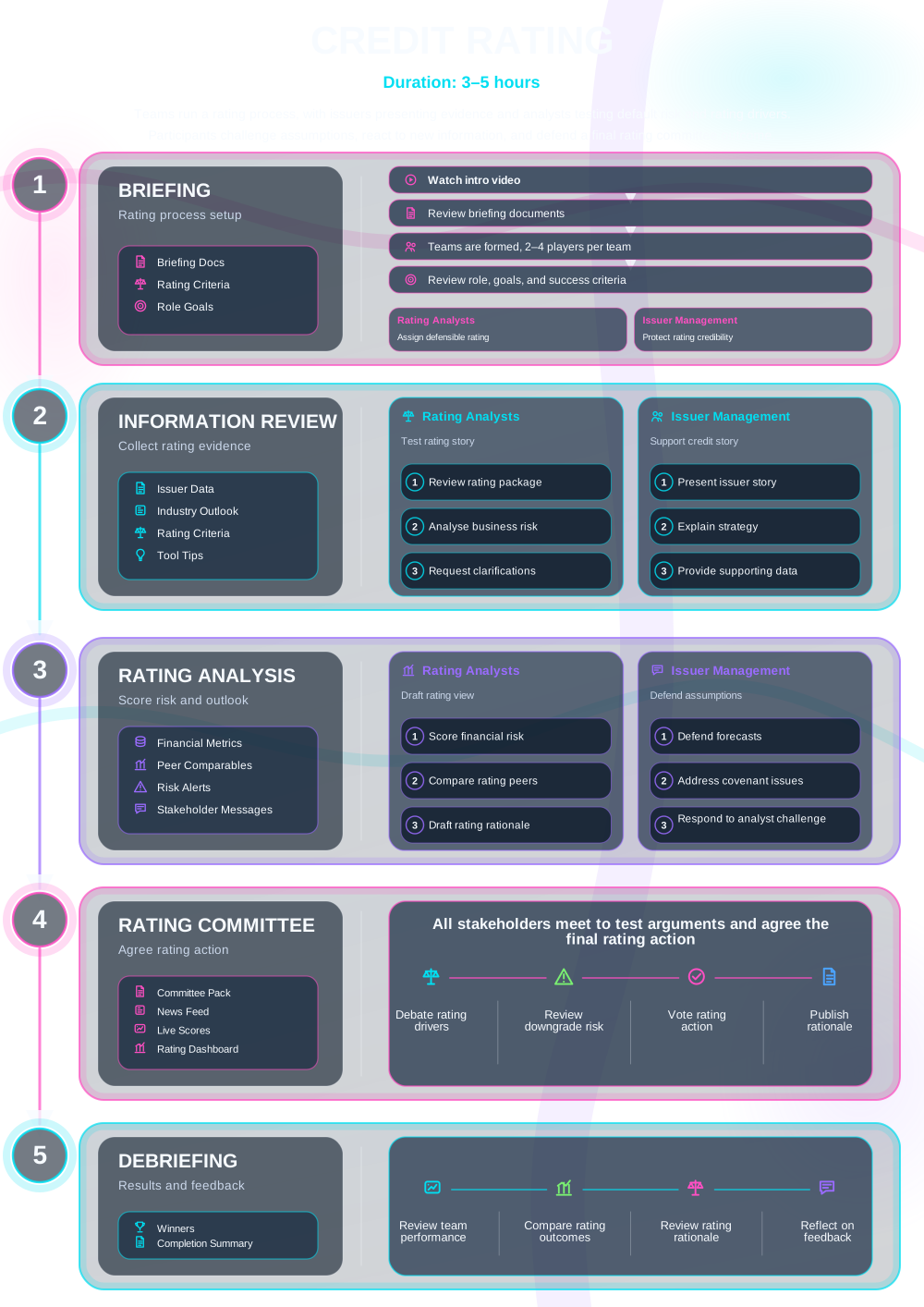

What Participants Do
In the simulation, participants will:
- Analyze company financials, business models, and industry data.
- Build financial models to project leverage, coverage, and liquidity ratios.
- Apply a structured rating methodology to assign preliminary credit scores.
- Engage in committee-style debates to justify and finalize a rating.
- Respond to external shocks, such as economic recessions or geopolitical events.
- Draft a formal credit rating report and present the rationale to stakeholders.

Learning Objectives
By the end of the simulation, participants will be able to:
- Understand the core principles and methodologies used by major credit rating agencies.
- Conduct comprehensive financial analysis to evaluate solvency and default risk.
- Build forecasts and assess a company’s resilience to economic stress.
- Articulate a clear, evidence-based credit rating rationale.
- Navigate the ethical and commercial pressures inherent in the rating industry.
- Explain how credit ratings influence debt pricing and investment decisions.
- Develop confidence in making high-stakes judgments with incomplete information.
How the Credit Rating Simulation Works
This simulation can be run individually or in teams in academic or corporate contexts. Each cycle represents a stage of getting through a pressing financial situation.
1. Receive the Case Dossier Teams are assigned a company (the "issuer") with financials, industry reports, and market data.
** 2. Conduct Initial Analysis** Participants dissect the financial statements, evaluate the business model, and research industry risks.
3. Model and Score Teams build projection models and apply the simulation's rating scorecard to arrive at a preliminary rating.
4. Rating Committee Teams present their analysis and proposed rating to a simulated "rating committee" (instructors or other teams), defending their position against challenge.
5. Navigate Market Events A new round introduces a market shock (like rising interest rates, a supply chain crisis), forcing teams to re-evaluate their rating.
6. Final Communication Teams produce a final rating report and deliver a concise summary to simulated investors.
Frequently Asked Questions
Assessment
Assessment of participant performance can be tailored according to the host institution’s objectives (business school, corporate training, assessment centre). Typical assessment criteria include:
- Accuracy of financial analysis, ratio calculation, and forecasting.
- Appropriateness of the final credit rating relative to the case fundamentals and subsequent "market" events.
- Ability to logically justify and defend the rating under scrutiny during the committee debate.
- Clarity, structure, and persuasiveness of the final credit rating report.
- How the team incorporates new information and adjusts its analysis in response to economic shocks.