It is ideal for MBA students, finance undergraduates, early-career bankers, and professionals in commercial lending, corporate banking, or private debt who want to solidify their credit skills.

Credit Analysis Simulation
Step into the shoes of a credit analyst at a major commercial bank, where you will evaluate real-world company cases, assess their financial health, and make critical recommendations that balance risk and reward.

Credit Analysis Simulation Overview
In today's volatile economic climate, the ability to accurately assess a borrower's creditworthiness is a fundamental skill for bankers, investors, and financiers. This simulation provides an immersive, hands-on experience in fundamental credit analysis. Participants are tasked with analyzing a potential corporate borrower seeking a significant loan.
You will delve into the company's industry, competitive position, management strategy, and—most critically—its financial statements. Using ratio analysis, cash flow modeling, and covenant structuring, you will build a comprehensive credit memorandum. The final challenge involves presenting your lending decision and term sheet to a credit committee, defending your analysis under scrutiny. This simulation bridges the gap between theoretical finance and the practical, judgment-based reality of credit decisions.
Although ideal for undergraduate and graduate finance courses, executive training, and corporate finance skill workshops, the simulation is modular and scalable, allowing instructors to vary complexity.

Credit Analysis Simulation Concepts
Participants work through realistic scenarios, which can be customized to emphasize or exclude specific topics depending on the learning goals. This modular structure allows the simulation to be tailored to any type of session. Key concepts include:
- The Five Cs of Credit
- Financial Statement Analysis
- Ratio Analysis
- Cash Flow Analysis
- Debt Capacity Modeling
- Loan Structuring
- Covenants
- Credit Memorandum
- Risk Rating

Gameflow

What Participants Do
In the simulation, participants will:
- Analyze a detailed case study of a company requesting financing.
- Perform a thorough fundamental analysis, including SWOT and industry review.
- Build integrated financial models to forecast future performance and debt capacity.
- Calculate and interpret key financial ratios and compare them to industry benchmarks.
- Structure a proposed loan, including size, terms, and pricing (interest rate).
- Draft a set of financial covenants to monitor the borrower's health.
- Prepare a professional Credit Memorandum summarizing the analysis and recommendation.
- Present and defend their lending decision in a simulated Credit Committee meeting.

Learning Objectives
By the end of the simulation, participants will be able to:
- Understand the end-to-end process of corporate credit analysis from a lender's perspective.
- Analyze a company's financial health and its ability to generate sufficient cash flow to service debt.
- Construct a financial model to project future performance and determine a company's debt capacity.
- Structure a syndicated or bilateral loan, including appropriate terms, covenants, and pricing based on risk.
- Synthesize quantitative and qualitative findings into a coherent Credit Memorandum.
- Recommend a clear lending decision (Approve, Deny, or Approve with Conditions) and justify it effectively.
How the Credit Analysis Simulation Works
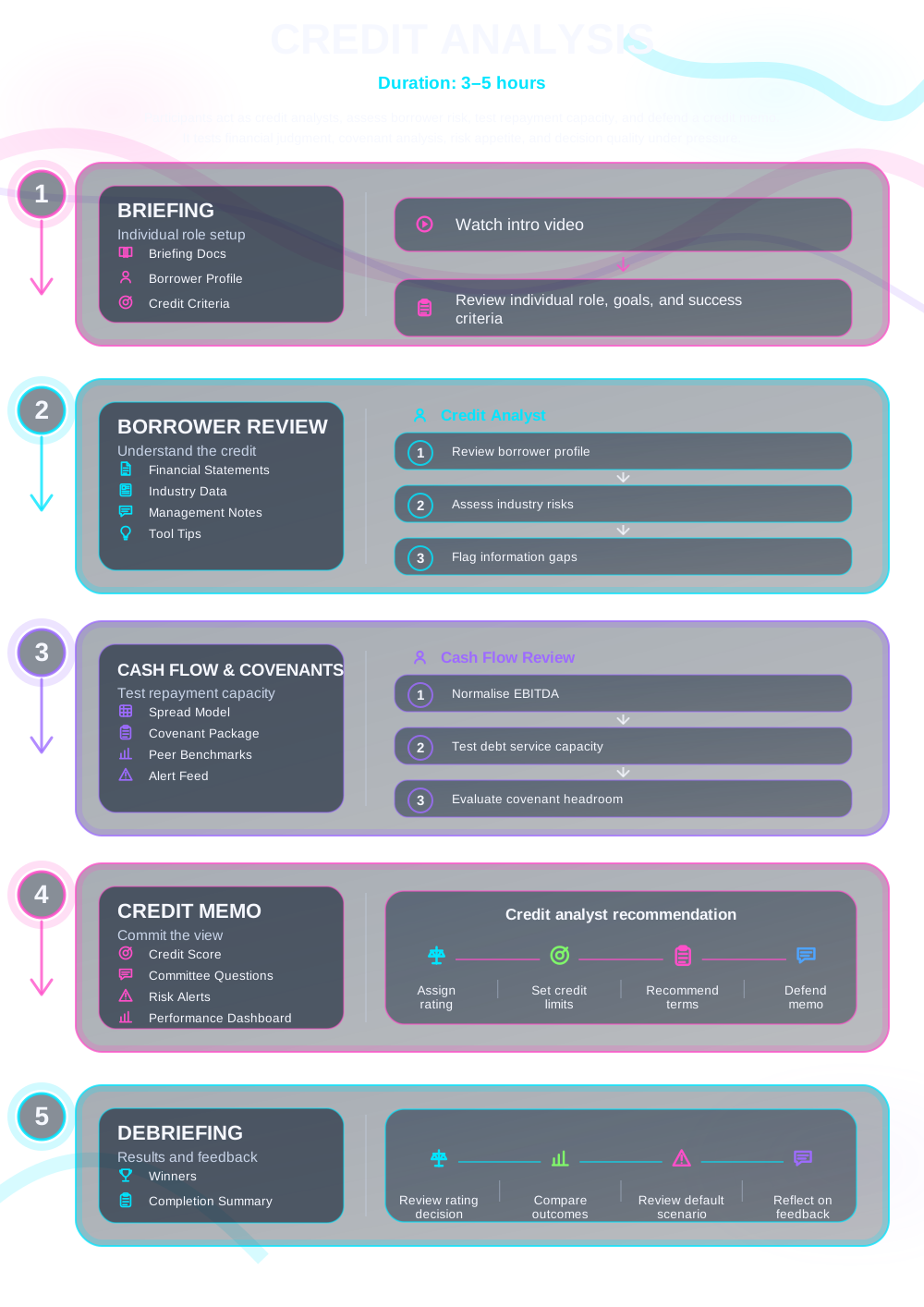
This simulation can be run individually or in teams in academic or corporate contexts. Each cycle represents a stage of getting through a pressing financial situation.
1. Introduction and Case Launch Participants are introduced to the bank's credit policy and receive the detailed case study of the corporate borrower.
2. Financial Analysis Phase Using provided financials and market data, participants analyze historical trends, build forecasts, and calculate key credit metrics.
3. Loan Structuring Phase Based on their analysis, participants design a term sheet, proposing the loan amount, interest rate, maturity, and covenants.
4. Credit Memo Submission Participants compile their analysis, recommendation, and term sheet into a formal Credit Memorandum.
5. Credit Committee Meeting Teams present their findings to a "Credit Committee" (composed of instructors or peers), answer challenging questions, and defend their final decision.
Frequently Asked Questions
Assessment
Assessment of participant performance can be tailored according to the host institution’s objectives (business school, corporate training, assessment centre). Typical assessment criteria include:
- Depth of financial analysis
- Accuracy of calculations
- Logical structuring of the loan.
- Accuracy, structure, and the validity of the assumptions used in the debt capacity forecast.
- Professionalism of the presentation
- The strength of the recommendation
- The ability to handle challenging questions from the committee.