This simulation is ideal for business school students, early-career bankers in commercial or corporate banking, finance professionals transitioning to lending roles, and any corporate finance practitioners seeking to understand the lender’s perspective.

Credit Analysis for Corporate Lending Simulation
This simulation challenges participants to act as credit analysts and loan committee members, evaluating corporate loan applications, assessing risks, structuring deals, and making pivotal lending decisions that balance profitability with prudence.

Credit Analysis for Corporate Lending Simulation Overview
In the Credit Analysis for Corporate Lending Simulation, participants are placed at the heart of a commercial bank’s lending division. They are presented with a portfolio of diverse corporate loan requests from companies across different industries, each with unique financial profiles, business models, and risk factors. Moving beyond theoretical ratios, the simulation requires a holistic analysis of quantitative financials and qualitative factors.
Participants must build integrated financial models to project debt serviceability, structure appropriate loan terms (amount, tenor, covenants, pricing), and defend their decisions in a simulated credit committee. The dynamic environment reacts to their choices, teaching the delicate art of saying “yes” with the right conditions or “no” with a clear rationale, thereby protecting the bank’s capital while seeking growth.
Although ideal for undergraduate and graduate finance courses, executive training, and corporate finance skill workshops, the simulation is modular and scalable, allowing instructors to vary complexity.

Credit Analysis for Corporate Lending Simulation Concepts
Participants work through realistic scenarios, which can be customized to emphasize or exclude specific topics depending on the learning goals. This modular structure allows the simulation to be tailored to any type of session. Key concepts include:
- The 5 Cs of Credit
- Financial Statement Analysis for Lending
- Cash Flow Analysis and Debt Service Coverage
- Loan Structuring: Tenor, Amortization, and Pricing
- Financial Covenant Design and Monitoring
- Credit Risk Grading and Probability of Default
- Qualitative Risk Assessment and Management Evaluation
- Credit Memorandum Writing and Committee Presentation

Gameflow
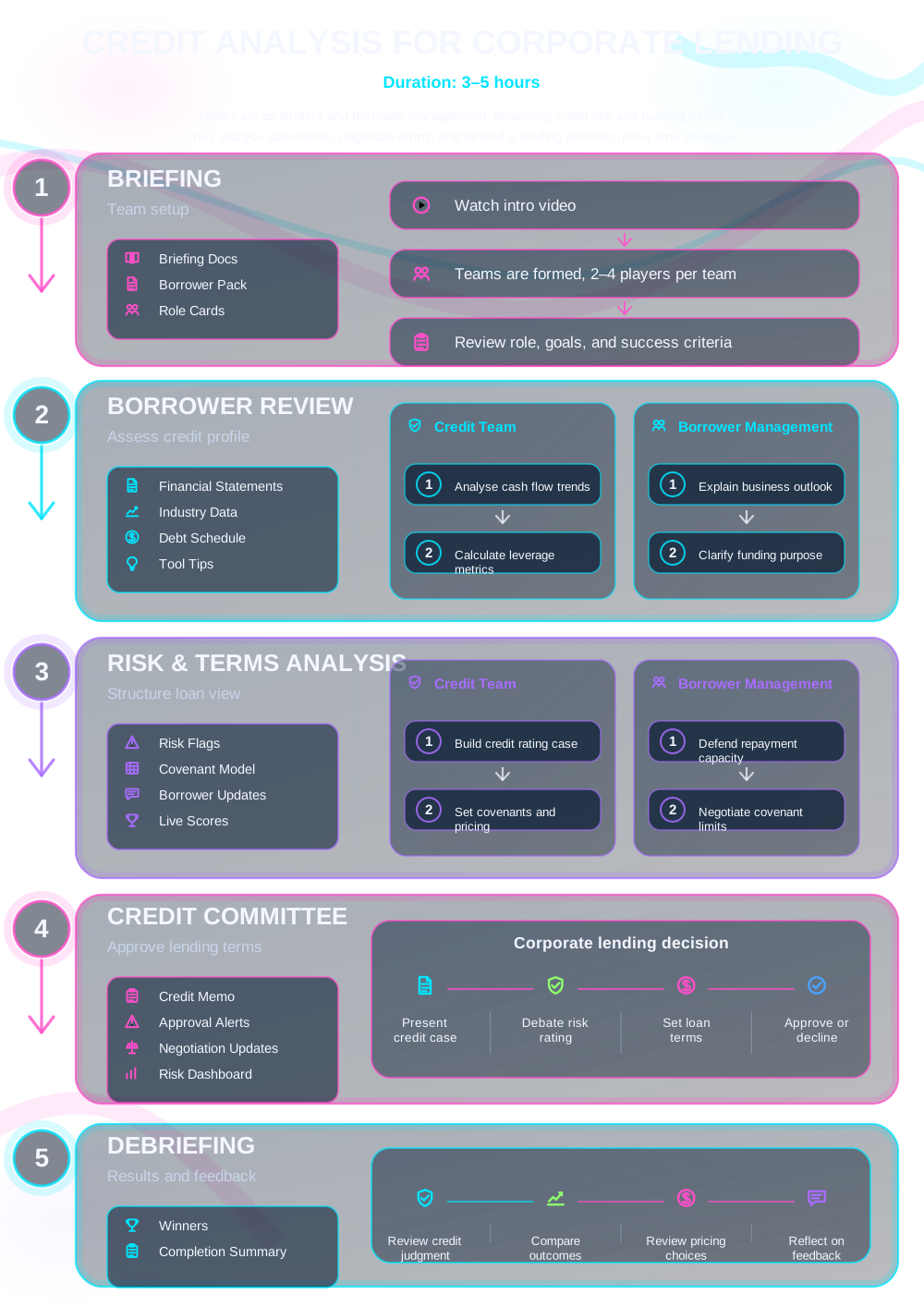

What Participants Do
In the simulation, participants will:
- Analyze full-scale corporate financial statements (Income Statement, Balance Sheet, Cash Flow).
- Build a dynamic loan model to forecast future cash flows and debt service capacity.
- Calculate and interpret key credit ratios and compare them to industry benchmarks.
- Structure specific loan terms, including size, interest rate, maturity, and amortization schedule.
- Draft and negotiate financial and performance covenants to mitigate risk.
- Prepare a professional Credit Approval Memo summarizing analysis and recommendations.
- Present and defend their lending proposal in a simulated Loan Credit Committee.
- Make a final approve/decline decision and monitor the outcome of their portfolio.

Learning Objectives
By the end of the simulation, participants will be able to:
- Develop Proficiency in analyzing corporate borrowers from a lender’s perspective.
- Apply Financial Analysis to assess a company’s ability to service and repay debt.
- Design and Structure a corporate loan, aligning terms with identified risks and opportunities.
- Understand the Role of covenants in protecting the lender and signaling early distress.
- Enhance Decision-Making and judgment skills under uncertainty and risk-return trade-offs.
- Improve Communication skills by articulating credit rationale clearly and concisely in written and oral formats.
How the Credit Analysis for Corporate Lending Simulation Works
This simulation can be run individually or in teams in academic or corporate contexts. Each cycle represents a stage of getting through a pressing financial situation.
1. Introduction and Role Assignment Participants are briefed on their role as Credit Analysts and introduced to the simulation platform and the bank’s risk appetite.
2. Deal Pipeline Review Teams receive a pipeline of 3-4 distinct corporate loan cases, each with a business summary and historical financials.
3. Deep Dive Analysis For each case, participants conduct quantitative modeling and qualitative research, using provided tools and data.
4. Structuring and Proposal Based on their analysis, participants structure a proposed loan and draft a formal Credit Approval Memo.
5. Credit Committee Teams present their top loan proposal to a simulated credit committee (instructors or peers), facing challenging questions.
6. Decision and Feedback Final decisions are locked in. The simulation provides dynamic feedback on the performance of the loan portfolio over time, showing the consequences of each decision.
7. Debrief A comprehensive review links simulation experiences to core credit principles and real-world banking practices.
Frequently Asked Questions
Assessment
Assessment of participant performance can be tailored according to the host institution’s objectives (business school, corporate training, assessment centre). Typical assessment criteria include:
- Evaluation of the correctness of financial models, ratio calculations, and cash flow projections.
- Assessment of the appropriateness of proposed loan terms (pricing, covenants, structure) relative to the identified risks.
- Scoring based on the clarity, completeness, and persuasiveness of the written recommendation and committee defense.
- The risk-adjusted return of the participant’s approved loan portfolio within the simulation.
- Qualitative feedback during the credit committee and final debrief sessions on analytical rigor and critical thinking.
- This multi-faceted approach ensures participants are assessed not just on numerical skills, but on the holistic judgment required of a proficient credit professional.