It is ideal for business school students (MBA, finance majors), corporate trainees in real estate firms, investment banks, pension funds, and professionals in related fields seeking to understand CRE investing.

Commercial Real Estate Simulation
This hands-on simulation immerses you in the full lifecycle of CRE investment: from acquisitions and financing to asset management and exit strategies. Compete to build the most profitable and resilient portfolio in a dynamic market.

Commercial Real Estate Simulation Overview
Our Commercial Real Estate Simulation places participants in the role of an investment firm managing a discretionary fund. Teams are tasked with deploying capital across a diverse set of property assets including office, retail, industrial, and multifamily, all within a simulated but economically realistic market.
Over multiple rounds, teams must analyze market data, underwrite deals, structure debt and equity financing, negotiate with lenders and brokers, manage operational performance, and decide when to hold, renovate, or sell assets.
The simulation incorporates real-world variables such as interest rate fluctuations, cap rate compression/expansion, tenant rollover risk, economic cycles, and unexpected "black swan" events. Success requires balancing risk and return, mastering capital structures, and thinking like a true principal investor.

Hedging Commercial Real Estate Concepts
Participants work through realistic scenarios, which can be customized to emphasize or exclude specific topics depending on the learning goals. This modular structure allows the simulation to be tailored to any type of session. Key concepts include:
- Property Valuation and Underwriting
- Capital Stack Structuring
- Market Analysis and Due Diligence
- Lease Economics
- Asset Management and Value-Add
- Exit Strategies
- Risk Assessment
- Portfolio Strategy

Gameflow
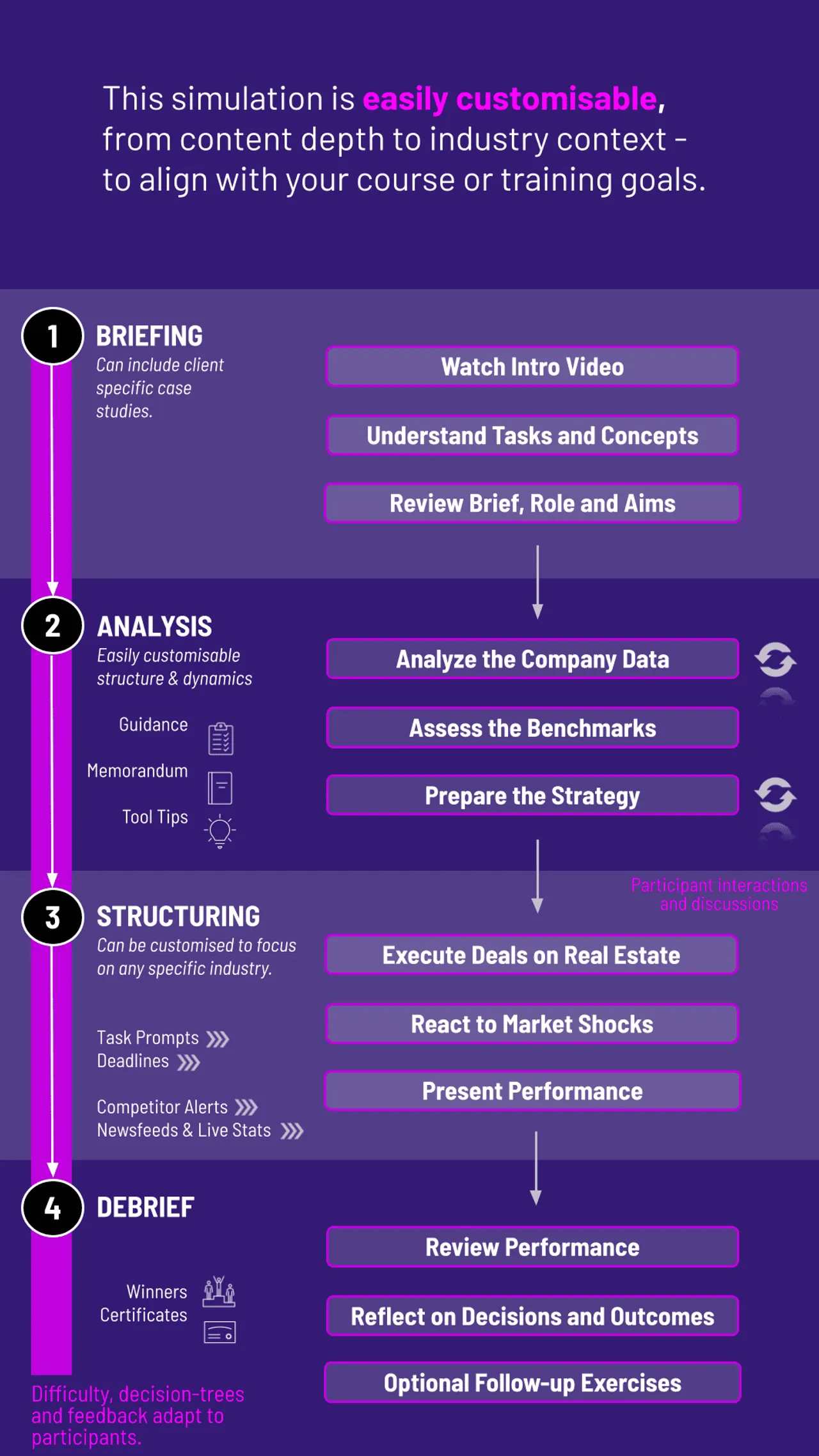

What Participants Do
In the simulation, participants will:
- Analyze offering memorandums for potential property acquisitions.
- Build detailed financial models to project returns and assess deal feasibility.
- Actively bid on properties in a competitive auction environment.
- Negotiate terms with a simulated debt syndicate to secure financing.
- Make critical capital allocation decisions: acquire new assets, invest in existing properties, or divest.
- Manage portfolio performance, reacting to quarterly market updates and random events.

Learning Objectives
By the end of the simulation, participants will be able to:
- Apply the core financial metrics and models used to underwrite commercial real estate investments.
- Evaluate the risk-return profile of different property types and capital structures.
- Structure a balanced commercial real estate portfolio aligned with an investment thesis.
- Articulate the impact of macroeconomic factors (interest rates, economic growth) on property values and investment decisions.
- Make strategic decisions regarding acquisition, asset management, and disposition to maximize long-term wealth.
- Function effectively within a team, assigning roles and making collective decisions under pressure.
How the Commercial Real Estate Simulation Works
This simulation can be run individually or in teams in academic or corporate contexts. Each cycle represents a stage of getting through a pressing financial situation.
1. Setup Teams are formed and receive initial capital. The simulation platform presents an initial market landscape with available properties, financing benchmarks, and economic indicators.
** 2. Analyze** Review new deal pipelines, property performance reports, and market news.
3. Decide Submit bids for properties, request financing, approve capital expenditures, and list properties for sale.
4. Execute The simulation engine processes all team decisions simultaneously, resolving auctions, financing, and market events.
5. Review Teams receive updated portfolio dashboards, P&L statements, and balance sheets, analyzing their performance to inform the next round.
6. Debrief The simulation culminates in a comprehensive review, comparing team strategies and outcomes, and linking the experience directly to core CRE finance principles.
Frequently Asked Questions
Assessment
Assessment of participant performance can be tailored according to the host institution’s objectives (business school, corporate training, assessment centre). Typical assessment criteria include:
- The Internal Rate of Return or Net Present Value of the team’s portfolio at simulation end, measuring financial acumen and execution.
- Secondary assessment includes analysis of the team’s debt-to-equity ratio, portfolio diversification, and vacancy rates, demonstrating risk management.
- Teams may submit brief rationale for key acquisitions or exits, evaluated for analytical depth and strategic alignment. Individual contribution, teamwork, and role-specific performance.
- Pre- and Post-Simulation Quizzes: Gauge the concrete improvement in understanding of key terminologies and calculations.
- Final Debrief Presentation: Teams present their strategy, outcomes, and lessons learned, fostering synthesis and communication of complex financial results.