Absolutely. Cash flow is critical for all business leaders. The simulation is designed to be intuitive, teaching practical, actionable skills without requiring an accounting degree.

Cash Flow Management Simulation
Go beyond the P&L statement and learn to forecast, manage, and strategically optimize cash flow in a dynamic, competitive business environment.

Cash Flow Management Simulation Overview
Profit is an opinion; cash is a fact. This immersive simulation places participants in the role of financial managers for a growing, mid-sized manufacturing company. Over multiple simulated fiscal quarters, teams must navigate sales volatility, supplier negotiations, investment decisions, and unforeseen economic shocks—all while ensuring the company never faces a liquidity crisis.
Unlike static exercises, this simulation reacts to your decisions in real-time, illustrating the direct impact of operational, investing, and financing choices on cash flow. Participants will experience the delicate balance between growth and solvency, learning that even profitable companies can fail if cash flow is mismanaged.
Although ideal for undergraduate and graduate finance courses, executive training, and corporate finance skill workshops, the simulation is modular and scalable, allowing instructors to vary complexity.

Cash Flow Management Simulation Concepts
Participants work through realistic scenarios, which can be customized to emphasize or exclude specific topics depending on the learning goals. This modular structure allows the simulation to be tailored to any type of session. Key concepts include:
- Cash Flow vs. Profit
- The Cash Conversion Cycle
- Working Capital Management
- Cash Flow Forecasting
- Liquidity Ratios and Solvency
- Financing Strategies
- Scenario and Sensitivity Analysis
- Stakeholder Communication

Gameflow

What Participants Do
In the simulation, participants will:
- Analyze starting financial statements and initial market conditions.
- Make quarterly operational decisions on pricing, production, and terms.
- Negotiate payment terms with suppliers and banks.
- Evaluate capital investment opportunities.
- Choose financing instruments to cover shortfalls or invest in growth.
- React to random economic events.
- Monitor a live, dynamic cash flow dashboard and update forecasts.
- Present a final cash flow strategy to the simulated "Board of Directors".

Learning Objectives
By the end of the simulation, participants will be able to:
- Construct and interpret detailed cash flow statements.
- Identify and mitigate key drivers of cash flow risk within a business model.
- Apply strategies to shorten the Cash Conversion Cycle and improve liquidity.
- Build a practical, rolling 12-month cash flow forecast.
- Evaluate the cash flow implications of investment and financing decisions.
- Make strategic trade-offs between aggressive growth and conservative cash preservation.
- Communicate cash flow performance and strategy effectively to stakeholders.
How the Cash Flow Management Simulation Works
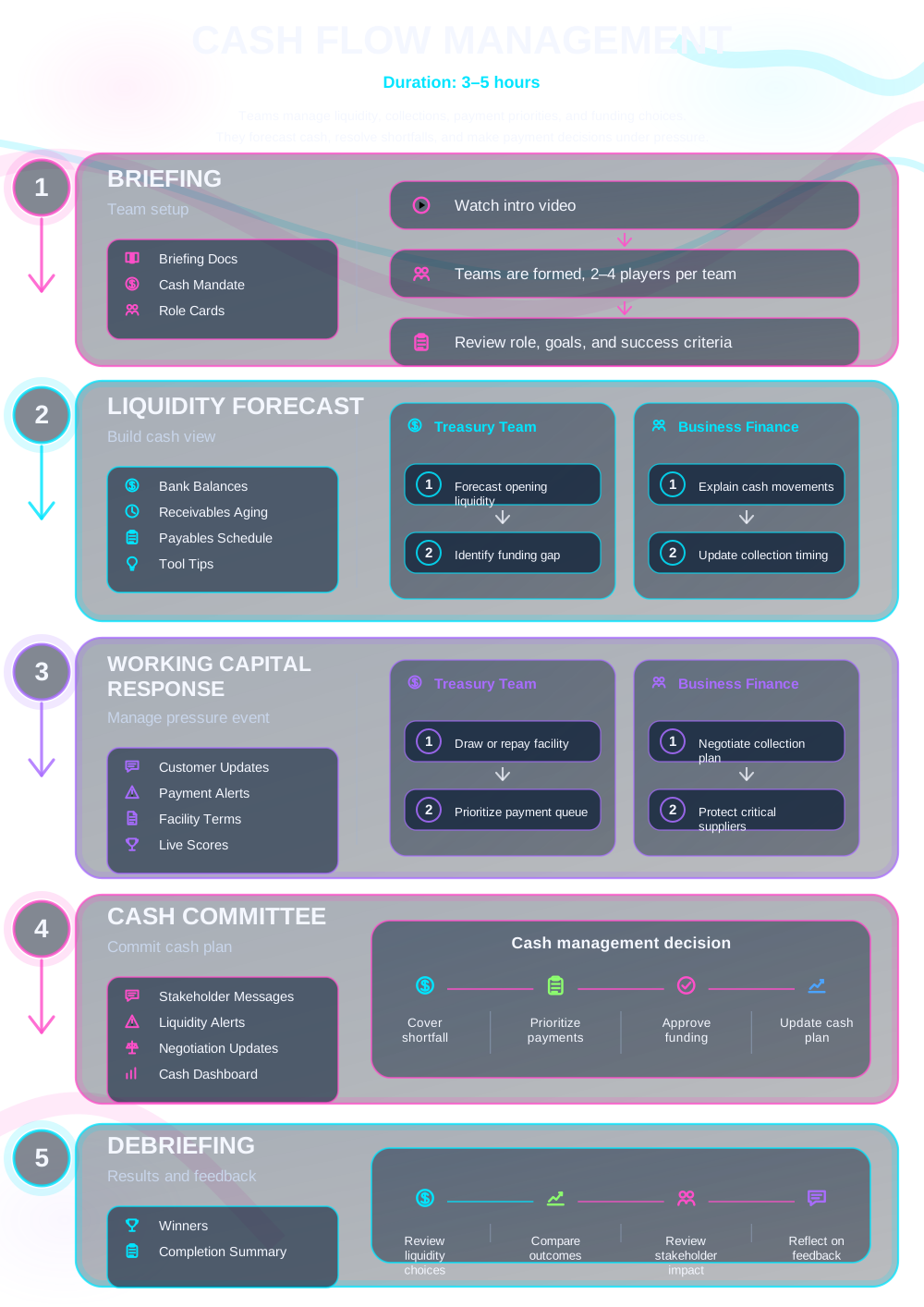
This simulation can be run individually or in teams in academic or corporate contexts. Each cycle represents a stage of getting through a pressing financial situation.
1. Team Formation Participants are grouped into management teams of 3-5.
2. Initial Briefing Receive the company’s financial history, market position, and Q1 forecast.
3. Decision Rounds Each round represents a fiscal quarter. Teams analyze data, use forecasting tools, and submit decisions on operations, financing, and investments.
4. Results and Feedback The simulation engine processes all decisions, generating updated financial statements, cash flow reports, and market rankings.
5. Economic Events Random events inject real-world uncertainty, forcing adaptive management.
6. Final Presentation Teams synthesize their performance into a board report, defending their strategy and lessons learned.
7. Debrief An instructor-led session ties simulation outcomes to core financial principles.
Frequently Asked Questions
Assessment
Assessment of participant performance can be tailored according to the host institution’s objectives (business school, corporate training, assessment centre). Typical assessment criteria include:
- Collaboration, division of work, integration of roles, and final coherence
- Rating by peers and self-reflection on approach and decisions
- Accuracy in judgement of company’s assets and quality of assumptions
- Ability to adapt and revise valuations in light of news shocks or changes