It is ideal for MBA students, finance undergraduates, junior analysts, and professionals in corporate roles seeking to understand how financial markets operate. It requires a basic understanding of financial concepts.

Capital Markets and Securities Simulation
The Capital Markets and Securities Simulation plunges participants into the high-stakes, fast-paced world of global finance, where participants, acting as traders and portfolio managers at competing investment firms, maximize their portfolio value.

Capital Markets and Securities Simulation Overview
In the Capital Markets and Securities Simulation participants will grapple with economic data releases, corporate news, geopolitical events, and the actions of other market participants, all while managing risk and adhering to a strategic mandate.
This is not a passive exercise; it is an immersive experience that builds intuition, sharpens analytical skills, and provides a visceral understanding of how capital markets function under pressure. During the simulation “news events” (sector shocks, regulatory changes, competitive earnings surprises) are introduced at key moments which force participants to revise their multiples and assumptions. It helps participants internalize the logic and pitfalls of peer-based valuation in a dynamic environment.
Although ideal for undergraduate and graduate finance courses, executive training, and corporate finance skill workshops, the simulation is modular and scalable, allowing instructors to vary complexity.

Capital Markets and Securities Simulation Concepts
Participants work through realistic scenarios, which can be customized to emphasize or exclude specific topics depending on the learning goals. This modular structure allows the simulation to be tailored to any type of session. Key concepts include:
- Market Mechanics and Liquidity
- Asset Valuation
- Economic Indicators
- Portfolio Management
- Risk Management
- Trading Psychology
- Derivatives
- Fixed Income

Gameflow
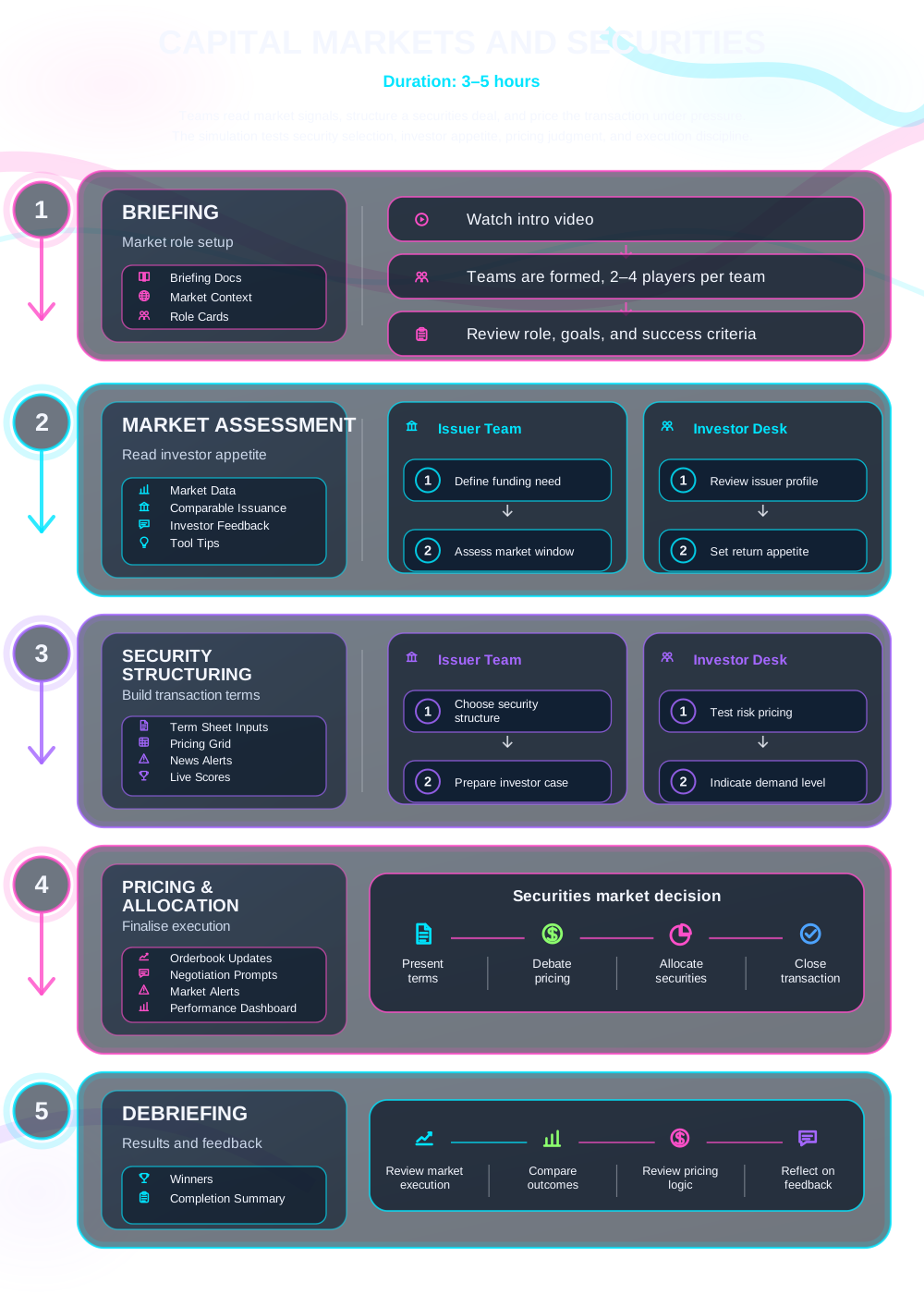

What Participants Do
In the simulation, participants will:
- Actively trade a diverse portfolio of equities, bonds, ETFs, and derivatives on a live, simulated platform.
- React to a simulated news feed with real-time economic data, earnings reports, and geopolitical events.
- Formulate and implement both long-term strategic asset allocation and short-term tactical trading strategies.
- Monitor portfolio risk metrics and employ hedging strategies to protect gains and limit losses.
- Compete against other teams to generate the highest risk-adjusted returns and absolute portfolio value.
- Justify their investment decisions and performance in a final debriefing session, mimicking a fund manager's report to stakeholders.

Learning Objectives
By the end of the simulation, participants will be able to:
- Analyze the direct impact of macroeconomic news and corporate events on different asset classes.
- Construct and manage a multi-asset investment portfolio aligned with a specific risk-return profile.
- Execute a variety of trade orders and understand their strategic implications.
- Apply core principles of risk management to protect portfolio value.
- Evaluate portfolio performance using industry-standard metrics.
- Articulate a coherent investment rationale, linking market analysis to specific trading decisions.
- Function effectively under pressure in a dynamic, team-based trading environment.
How the Capital Markets and Securities Simulation Works
This simulation can be run individually or in teams in academic or corporate contexts. Each cycle represents a stage of getting through a pressing financial situation.
1. Team Formation and Briefing Participants are divided into teams, each managing a virtual investment fund with a defined seed capital.
2. Platform Training A guided session familiarizes participants with the trading platform's interface, tools, and order types.
3. Live Simulation Rounds The core experience consists of multiple accelerated trading sessions, representing weeks or months of market activity. Each round is driven by a new set of economic data and news events.
4. Decision-Making and Execution Teams analyze information, decide on their strategy, and execute trades. The instructor acts as the central bank and can introduce unexpected market shocks.
5. Performance Review Between rounds, teams review their P&L, portfolio composition, and risk metrics to adjust their strategy for the next session.
6. Final Debrief The simulation concludes with a comprehensive review of market outcomes, team rankings, and a facilitated discussion linking the experience to theoretical concepts.
Frequently Asked Questions
Assessment
Assessment of participant performance can be tailored according to the host institution’s objectives (business school, corporate training, assessment centre). Typical assessment criteria include:
- Portfolio Performance
- Assesses the quality of participants' thought process.
- Professionalism, structure, persuasiveness, and effective use of visual aids during the presentation.
- Ability to think on foot, handle objections, and defend strategic choices under pressure from the "client".