It's ideal for finance professionals, MBA students, operations managers, and any executive involved in strategic planning and long-term investment decisions.

Capital Expenditure Simulation
In this Capital Expenditure Simulation, participants step into the role of senior finance executives and operations managers, tasked with making critical, long-term investment decisions to drive corporate growth and efficiency.

Capital Expenditure Simulation Overview
Participants are thrust into the high-stakes world of strategic corporate investment, where they must navigate the entire lifecycle of major capital projects. Each simulation round introduces new variables, shifting market demands, emerging technological disruptions, supply chain constraints, or changes in corporate strategic priorities.
Acting as a cross-functional leadership team, they must evaluate potential projects, build robust financial models, secure funding, and manage the execution and post-audit of their investments. The simulation emphasizes the practical application of capital budgeting techniques, from initial screening to final performance review, within a dynamic and uncertain business environment. It highlights how these long-term investments impact financial statements, competitive positioning, and shareholder value.
This simulation is ideal for MBA programs, executive finance training, and corporate workshops focused on strategic planning and financial management. It transforms abstract capital budgeting concepts into a tangible, decision-driven experience that mirrors the challenges faced by CFOs and VPs of Operations.

Capital Expenditure Simulation Concepts
Participants work through realistic scenarios, which can be customized to emphasize or exclude specific topics depending on the learning goals. This modular structure allows the simulation to be tailored to any type of session. Key concepts include:
- Capital budgeting techniques
- Strategic alignment of CapEx with corporate goals
- Forecasting capital costs and future cash flows
- Risk assessment, scenario analysis, and sensitivity testing
- Capital rationing and portfolio optimization of multiple projects
- Cost of capital and hurdle rate determination
- Post-investment audit and performance tracking
- Impact of CapEx decisions on financial statements and key ratios
- Managing stakeholder communication and securing board approval
- Ethical considerations and ESG integration in major investments

Gameflow
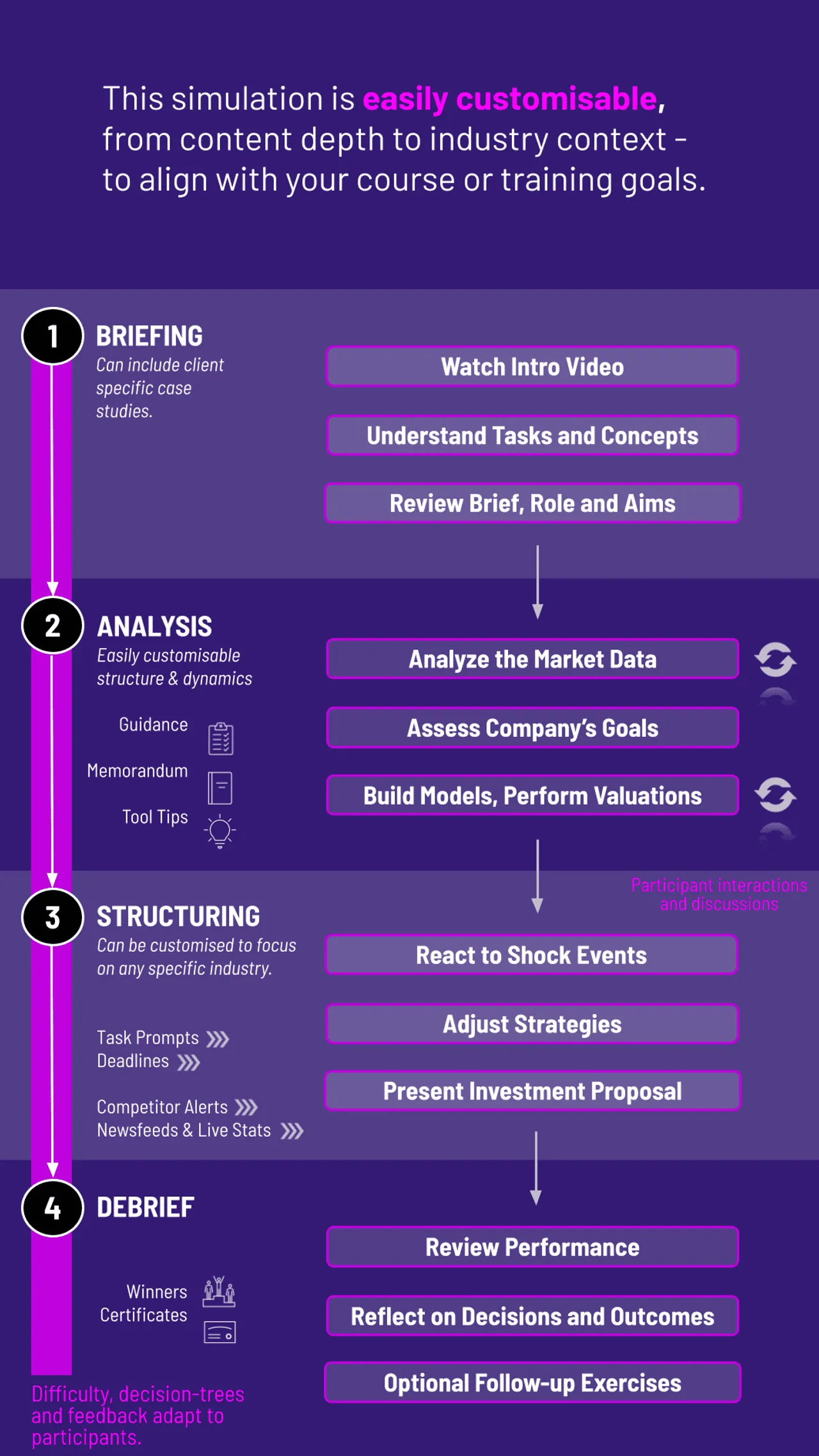

What Participants Do
In the simulation, participants will:
- Screen and prioritize a pipeline of potential investment opportunities.
- Build detailed financial models to forecast costs, revenues, and cash flows.
- Conduct in-depth risk analysis using sensitivity and scenario planning.
- Negotiate for limited capital funds against other teams or projects.
- Present a formal investment proposal to a simulated "Board of Directors".
- Monitor project execution, manage unforeseen complications, and conduct a final post-audit review.
- Reflect on the strategic and financial outcomes of their decisions.

Learning Objectives
By the end of the simulation, participants will be able to:
- Apply core capital budgeting methodologies to evaluate long-term projects.
- Build and interpret financial models for capital investment decisions.
- Quantify and mitigate risks associated with large capital outlays.
- Optimize a portfolio of projects under capital constraints.
- Align investment proposals with overarching business strategy.
- Communicate the value and risk of a capital project effectively to stakeholders.
- Understand the broad impact of CapEx on a company's financial health and operational capabilities.
- Develop confident, analytical decision-making skills for high-stakes investments.
How the Capital Expenditure Simulation Works
This simulation can be run individually or in teams in academic or corporate contexts. Each cycle represents a stage of getting through a pressing financial situation.
1. Receive the Strategic Brief Teams are introduced to their company's strategic goals and a set of potential capital projects.
** 2. Analyze Opportunities** They review project data, market forecasts, and corporate financials to shortlist viable investments.
3. Model and Decide Teams build financial models, perform valuations and risk assessments, and decide which project(s) to pursue.
4. Collaborate and Negotiate Teams role-play as different business units competing for a central capital budget or collaborate as a single management committee.
5. Present and Defend Teams formalize and present their investment proposal, defending it under scrutiny.
6. Review and Reflect After "execution," teams receive feedback on financial performance, strategic fit, and risk management, allowing them to adapt their strategy for subsequent rounds.
Frequently Asked Questions
Assessment
Assessment of participant performance can be tailored according to the host institution’s objectives (business school, corporate training, assessment centre). Typical assessment criteria include:
- Accuracy and depth of the financial models and valuation outputs.
- Clarity and strength of the strategic rationale for the investment.
- Thoroughness of identified risks and proposed mitigation strategies.
- Effectiveness and professionalism of the final investment proposal presentation.
- Ability to work effectively in a team to reach a consensus-driven decision.