It is perfect for students in finance, business, or economics programs, as well as professionals in early-career roles in investing, corporate finance, or financial planning who need to master the practical application of asset pricing models.

Capital Asset Pricing Model Simulation
In this Capital Asset Pricing Model Simulation, participants step into the role of portfolio managers and financial analysts applying the foundational CAPM to make critical investment decisions, construct optimal portfolios, and communicate strategy.

Capital Asset Pricing Model Simulation Overview
This simulation immerses participants in the practical application of the Capital Asset Pricing Model, one of the most pivotal concepts in modern finance. Acting as asset managers, participants navigate multiple market cycles where they must estimate required returns, assess company risk through beta, and build portfolios that strategically balance risk and reward to outperform benchmarks and meet client objectives.
The experience is built around realistic financial scenarios where market conditions, risk-free rates, and equity risk premiums shift. Participants must analyze company profiles, historical data, and macroeconomic indicators to calculate cost of equity, make informed investment allocations, and justify their decisions.
It is ideal for university finance courses, MBA programs, and corporate training workshops, providing a memorable, applied understanding of how theoretical models drive real-world investment strategy and valuation.

Capital Asset Pricing Model Simulation Concepts
Participants work through realistic scenarios, which can be customized to emphasize or exclude specific topics depending on the learning goals. This modular structure allows the simulation to be tailored to any type of session. Key concepts include:
- The Security Market Line and its application
- Calculating and interpreting beta as a measure of systematic risk
- Estimating the market risk premium and risk-free rate
- Determining required rates of return for individual assets and portfolios
- Portfolio construction, diversification, and the efficient frontier
- Alpha generation and performance measurement against the CAPM benchmark
- Critiques and limitations of the CAPM in practical settings
- Applying CAPM in corporate finance for project valuation and cost of capital

Gameflow

What Participants Do
In the simulation, participants will:
- Analyze company financials and market data to estimate asset betas.
- Calculate required rates of return using the CAPM formula for various securities.
- Construct and rebalance investment portfolios to achieve target risk/return profiles.
- Pitch portfolio strategies and investment theses to simulated clients or committees.
- Respond to dynamic market shocks, such as changes in interest rates or market volatility.
- Evaluate portfolio performance using metrics like Sharpe ratio and alpha.

Learning Objectives
By the end of the simulation, participants will be able to:
- Explain the components and underlying assumptions of the Capital Asset Pricing Model.
- Calculate a company's cost of equity using the CAPM framework.
- Differentiate between systematic and unsystematic risk.
- Construct a diversified portfolio and explain its position relative to the Security Market Line.
- Apply CAPM to make informed investment decisions and valuations.
- Communicate complex financial concepts and portfolio strategy effectively to stakeholders.
- Critique the practical usefulness and limitations of the CAPM.
How the Capital Asset Pricing Model Simulation Works
This simulation can be run individually or in teams in academic or corporate contexts. Each cycle represents a stage of getting through a pressing financial situation.
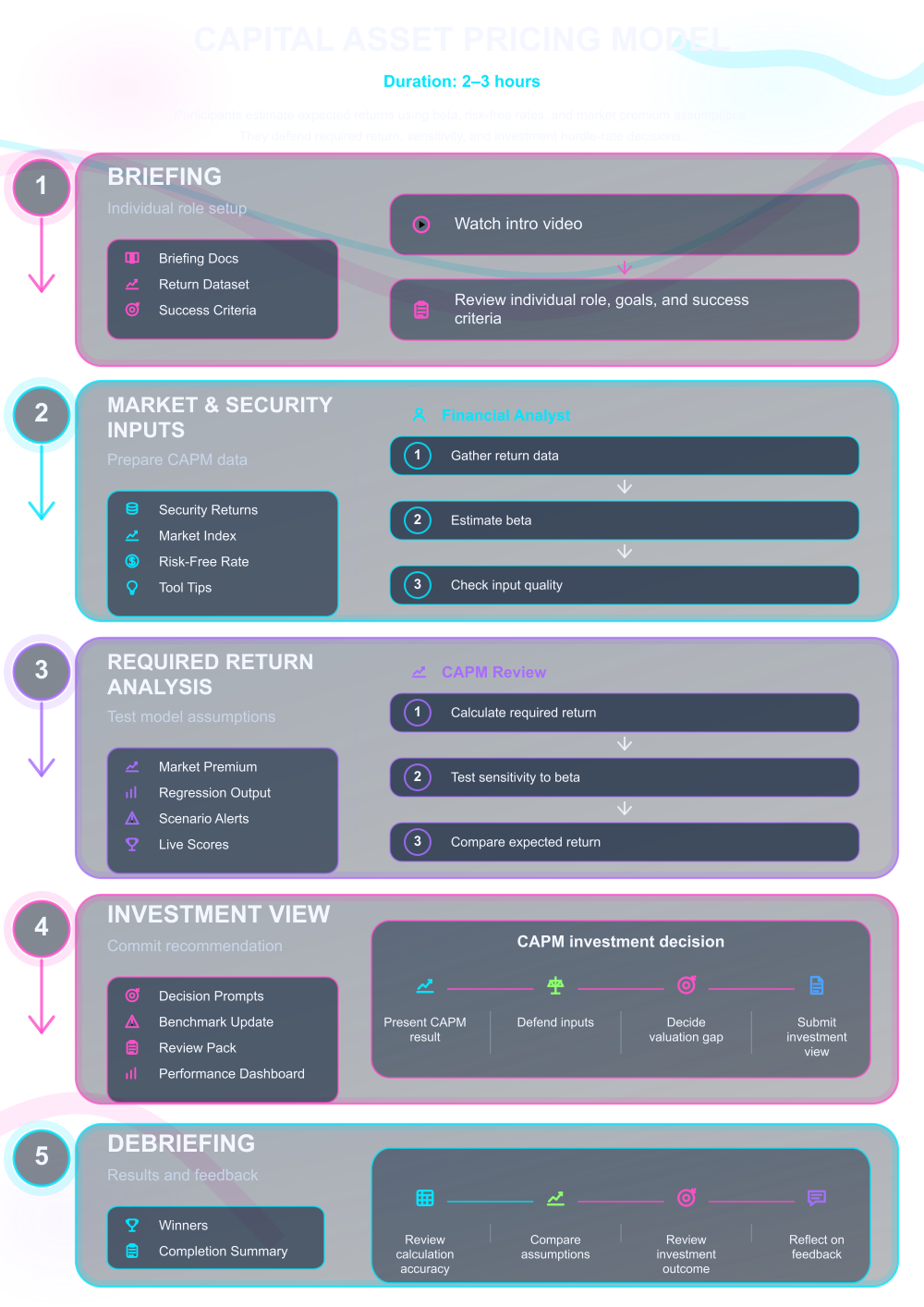
1. Receive the Market Brief Participants are introduced to the economic landscape, including current risk-free rates, expected market returns, and a set of potential investment opportunities.
** 2. Conduct Financial Analysis** They analyze provided data on companies, estimate betas, and calculate required returns using the CAPM formula.
3. Make Investment Decisions Participants allocate funds across securities to build a portfolio that aligns with a given mandate.
4. Collaborate and Negotiate In team settings, members debate strategies, align on risk tolerance, and prepare client communications.
5. Communicate Strategy Teams present their portfolio rationale, highlighting CAPM-based valuations and risk assessments.
6. Review Outcomes and Reflect The simulator generates performance reports, showing returns vs. the benchmark. Facilitated debriefs connect outcomes to theoretical concepts, guiding strategy evolution for the next round.
Frequently Asked Questions
Assessment
Assessment of participant performance can be tailored according to the host institution’s objectives (business school, corporate training, assessment centre). Typical assessment criteria include:
- Correct application of the CAPM formula and beta estimation.
- Risk-adjusted returns relative to the market benchmark.
- Quality and justification of investment choices.
- Clarity and persuasiveness in presenting the portfolio strategy.
- Effectiveness in group discussions and decision-making (for team-based runs).