It is ideal for finance students (BSc, MSc, MBA), aspiring analysts, and professionals in related fields (like investment banking) who want to understand the capital allocation and portfolio management perspective of asset managers, pension funds, and hedge funds.

Buy Side Simulation
In this Buy Side Simulation, participants step into the roles of professional investors at an asset management firm or investment fund, competing to analyze opportunities, construct portfolios, and generate the highest risk-adjusted returns.

Buy Side Simulation Overview
This simulation immerses participants in the competitive world of institutional investing. Acting as portfolio managers and analysts for a buy-side firm, teams are tasked with deploying capital across various asset classes—including public equity, fixed income, and private equity—to meet specific client mandates and performance benchmarks.
Each decision cycle presents a dynamic market environment shaped by economic data releases, corporate earnings, geopolitical events, and shifting monetary policy. Participants must conduct fundamental and technical analysis, perform due diligence on potential investments, and make critical allocation decisions.They balance the pursuit of alpha against stringent risk parameters, client liquidity needs, and compliance requirements.
The simulation captures the essence of buy-side culture: deep research, disciplined strategy, and performance measured against both the market and peers.

Buy Side Simulation Concepts
Participants work through realistic scenarios, which can be customized to emphasize or exclude specific topics depending on the learning goals. This modular structure allows the simulation to be tailored to any type of session. Key concepts include:
- Fundamental Equity Analysis and Valuation
- Portfolio Theory and Asset Allocation
- Alternative Investments
- Fixed Income Analysis
- Active vs. Passive Management
- Risk Management
- Investment Mandates and Client Reporting
- ESG/SRI Integration
- Behavioral Finance
- Performance Attribution

Gameflow
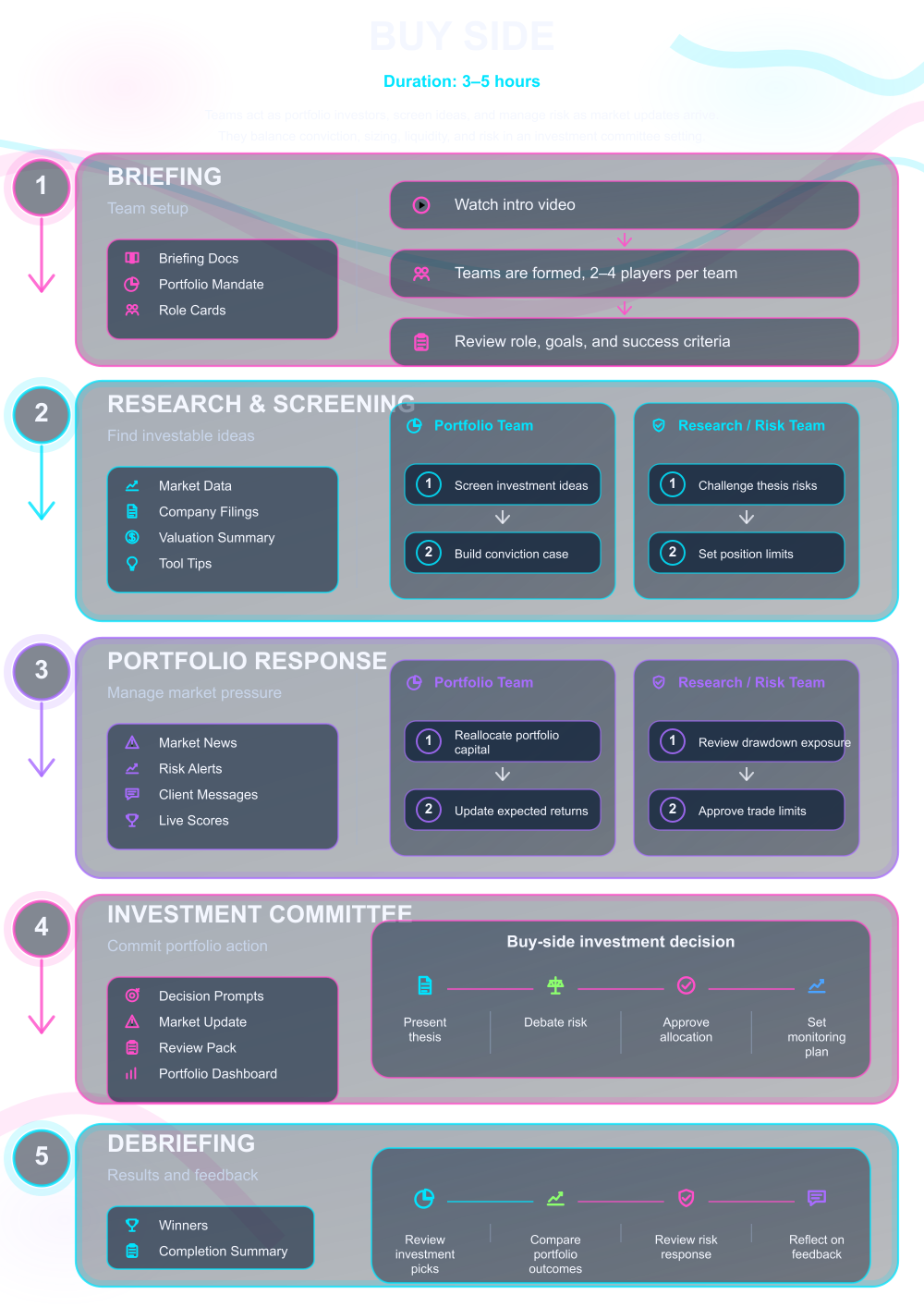

What Participants Do
In the simulation, participants will:
- Conduct deep dives on potential investments across different asset classes.
- Create and interpret valuation models to determine intrinsic value.
- Allocate capital based on a strategic mandate and tactical views.
- Monitor and adjust portfolio beta, sector concentration, and credit quality.
- Pivot strategy in response to simulated economic crises or black swan events.
- Defend stock picks or allocation changes to a simulated investment committee.
- Analyze benchmark-relative performance and attribution reports to refine strategy.

Learning Objectives
By the end of the simulation, participants will be able to:
- Understand the structure, roles, and objectives of buy-side institutions.
- Apply core valuation methodologies to assess investment opportunities.
- Construct a diversified portfolio aligned with a specific investment mandate and risk tolerance.
- Implement practical risk management frameworks and tools.
- Evaluate the role and analysis of fixed income and alternative investments in a total portfolio.
- Articulate investment theses and performance results clearly and persuasively.
- Develop disciplined investment decision-making processes under conditions of uncertainty and market stress.
How the Buy Side Simulation Works
This simulation can be run individually or in teams in academic or corporate contexts. Each cycle represents a stage of getting through a pressing financial situation.
1. Receive the Mandate Teams are assigned a specific client profile (growth pension fund, conservative endowment) with clear return objectives and risk constraints.
** 2. Research and Due Diligence** Participants analyze a universe of securities, using provided financial data, research reports, and macro-economic indicators.
3. Make Allocation Decisions Teams decide on their strategic asset allocation and select specific securities, submitting their target portfolio.
4. Navigate Live Market Rounds Over several simulated time periods, new market data and events are released, forcing teams to re-evaluate their holdings.
5. Present to the Committee Teams may be required to justify their portfolio decisions or pitch a new idea to a simulated investment committee.
6. Review Outcomes and Reflect Each round concludes with detailed performance feedback, including risk metrics, benchmark comparison, and peer ranking. Teams use this to adapt their strategy for the next round.
Frequently Asked Questions
Assessment
Assessment of participant performance can be tailored according to the host institution’s objectives (business school, corporate training, assessment centre). Typical assessment criteria include:
- Risk-adjusted returns (Sharpe ratio), benchmark outperformance (alpha), and downside risk control.
- Depth of analysis, valuation methodology, and adherence to the stated mandate.
- Responsiveness to new information and quality of portfolio rebalancing decisions.
- Clarity and persuasiveness of investment pitches and collaboration within the team.