No deep expertise is required. Basic familiarity with banking concepts (capital, liquidity, risk) helps, but the simulation provides instructional support and builds from foundational to advanced levels.

Basel Regulations Simulation
In this simulation participants step into the role of a bank’s senior risk and compliance team navigating the requirements of Basel III (and its evolving framework) and apply them in a competitive, decision-based scenario.

Basel Regulations Simulation Overview
Participants take charge of banking institutions operating under regulatory scrutiny. The simulation replicates a series of rounds in which they must manage capital, liquidity and leverage while responding to shocks, regulatory updates and competitive pressures.
Each team is responsible for managing transactions and resources while obliging to Basel’s regulations. Scenarios will evolve: credit cycles, market stress, regulatory cliff-events, and peer competition.
During the simulation “news events” (sector shocks, regulatory changes, competitive earnings surprises) are introduced at key moments which force participants to revise their multiples and assumptions. It helps participants internalize the logic and pitfalls of peer-based valuation in a dynamic environment. Simulation pushes participants to see and recognise reasoning for those regulations and the need to adhere to them.

Basel Regulations Simulation Concepts
Participants work through realistic scenarios, which can be customized to emphasize or exclude specific topics depending on the learning goals. This modular structure allows the simulation to be tailored to any type of session. Key concepts include:
- Common Equity Tier 1 capital, Tier 1 capital, Total capital ratios and how they relate to risk-weighted assets
- Leverage ratio and its role as a back-stop to risk-weighted measures
- Liquidity standards: Liquidity Coverage Ratio and Net Stable Funding Ratio
- Macro-prudential dimension of regulation and capital buffers
- Risk-weighted asset calculation
- Stress testing, business model resilience, regulatory implementation timeline

Gameflow
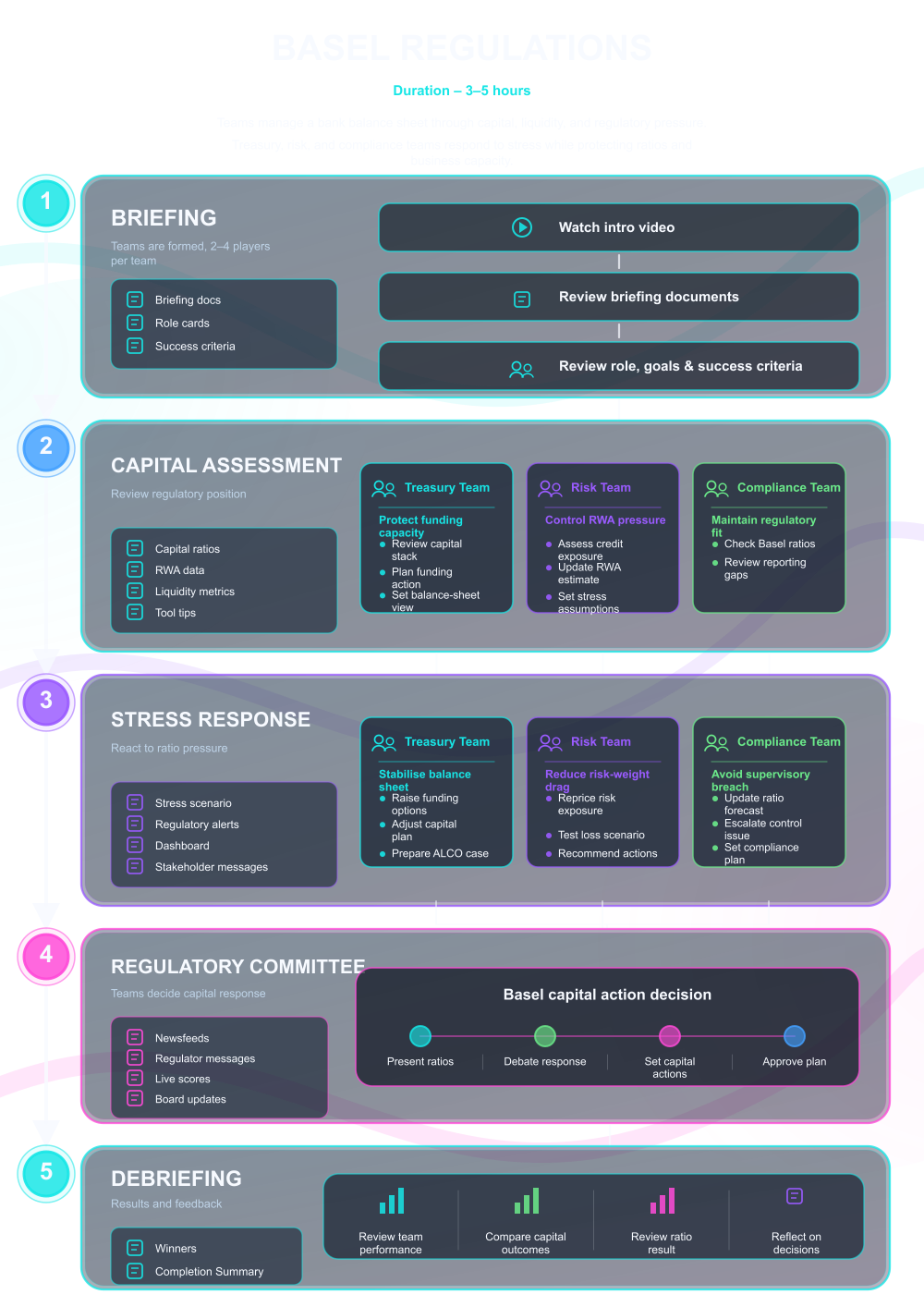

What Participants Do
In the simulation, participants will:
- Analyse the bank’s business model, risk profile and regulatory baseline
- Calculate and simulate compliance with Basel ratios under various scenarios
- Make strategic decisions: raise capital, shrink or re-allocate RWAs, adjust business lines, alter funding mix, hedge or reduce exposures
- Respond to regulatory updates or surprise events
- Communicate decisions internally under time pressure
- Compare performance across rounds/teams: measure how well banks stay compliant while maintaining profitability, competitiveness and growth
- Reflect and debrief: review outcomes, discuss which strategies succeeded or failed, and link decisions to regulatory mechanics

Learning Objectives
By the end of the simulation, participants will be able to:
- Understand the nature of uncertainty and how executives must make decisions without full information
- Apply scenario-planning and adaptive thinking in strategic leadership contexts
- Make resource allocation decisions that balance growth, risk and resilience
- Detect early signals of disruption or competitive shifts and respond appropriately
- Communicate strategic choices and rationale clearly to diverse stakeholders under pressure
- Learn how to pivot strategy dynamically in response to new data or environmental changes
- Build confidence in leading through ambiguity, not just in stable environments
- Enhance collaboration across functions (strategy, operations, finance, communications) under uncertain conditions
- Use feedback loops (metrics, outcomes) to refine decisions and close the “learning loop”
The simulation’s flexible structure ensures that these objectives can be calibrated to match the depth, duration, and focus areas of each program, whether in higher education or corporate learning.
How the Basel Regulations Simulation Works
This simulation can be run individually or in teams in academic or corporate contexts.
1. Make Financial Decisions Teams choose strategic moves (capital raise, business reduction, funding shift, hedging) under defined constraints and timing.
2. Respond to Shock Events The system introduces regulatory change or stress forcing teams to react.
3. Update your Strategy Accordingly The simulation calculates updated ratios, profitability, risk exposures and gives performance summaries.
4. Prepare and Present a Memo Teams prepare a board/ investor memo or regulatory submission based on their decisions and outcomes.
5. Review Performance Participants review performance, identify learning points, adjust their strategy, and begin the next round with updated context.
Frequently Asked Questions
Assessment
Following the simulation, participants are assessed on multiple dimensions:
- Compliance to the regulatory metrics
- Ability to effectively strategise under pressure
- Flexibility in face of shock events
- Clarity and quality of investor/board/regulator memos or presentations.
- Depth and logic of scenario analysis and sensitivity ranges
- Rating by peers and self-reflection on approach and decisions (optional)
Assessment can combine numeric scoring, qualitative feedback, peer review, and instructor debriefing. This flexibility allows the simulation to serve both graded university courses and corporate finance training environments.