The content is tailored for Business School Professors, Corporate Trainers in financial institutions, and MBA or Finance Masters Students seeking advanced, practical training, although the simulation can be adapted to any skill level.

Asset Securitization Simulation
Our Asset Securitization Simulation plunges participants into the heart of structured finance, providing a hands-on, dynamic environment to structure, price, and issue Asset-Backed Securities.

Asset Securitization Simulation Overview
In this intensive simulation, participants step into the role of a structuring team at a financial institution. Your team's goal is to acquire a pool of illiquid assets (such as auto loans, mortgages, or credit card receivables) and securitize them into a financial product that can be sold to investors.
You will be responsible for every critical decision: analyzing the credit quality of the underlying assets, designing the tranche structure, modeling cash flows, setting coupon rates to attract investors while maximizing profit, and navigating the inherent risks of prepayment and default.
The simulation runs over multiple periods, reflecting the long-term nature of these instruments. Teams compete to achieve the highest profitability and market share by creating the most efficient and attractive securities, responding to changing economic conditions and investor appetite.

Asset Securitization Simulation Concepts
Participants work through realistic scenarios, which can be customized to emphasize or exclude specific topics depending on the learning goals. This modular structure allows the simulation to be tailored to any type of session. Key concepts include:
- Asset-Backed Securities
- Special Purpose Vehicle
- Tranching
- Credit Enhancement
- Waterfall Structure
- Prepayment Risk
- Default Risk and Loss Analysis
- Credit Ratings
- Weighted Average Life
- Debt Yield and Spread

Gameflow
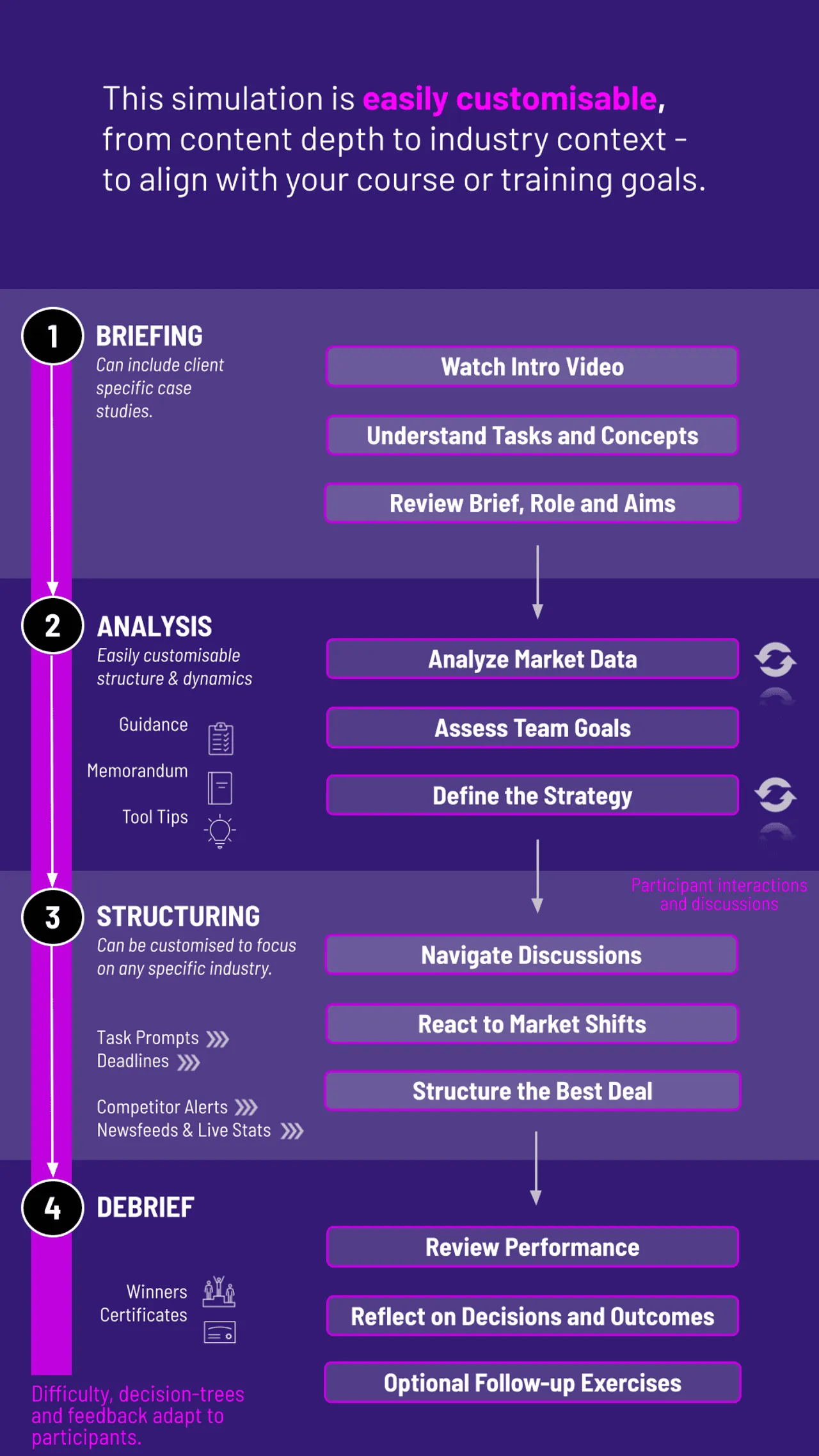

What Participants Do
In the simulation, participants will:
- Evaluate and purchase a pool of underlying assets based on credit quality and yield.
- Design the capital stack by creating multiple tranches to cater to different investor risk appetites.
- Build and run cash flow models to project payments to each tranche under various economic scenarios.
- Set coupon rates for each tranche to make them attractive to investors while ensuring the overall deal is profitable.
- Market your securities to a simulated investor community, adjusting your strategy based on their feedback and demand.
- Monitor the performance of your issued securities over time, managing risks like prepayments and defaults.
- Compete against other teams to achieve the highest profitability and become the top structuring desk in the simulation.

Learning Objectives
By the end of the simulation, participants will be able to:
- Deconstruct the complete lifecycle of an asset-backed security, from origination to maturity.
- Analyze the risk and return characteristics of a pool of underlying assets.
- Design a multi-tranche capital structure that efficiently distributes risk and return.
- Apply credit enhancement techniques to achieve desired credit ratings for various tranches.
- Model the cash flow waterfall and calculate payments for different tranches under stress scenarios.
- Evaluate the key risks in securitization, including prepayment, default, and interest rate risk.
- Price tranches by balancing investor yield demands with the cost of funding for the issuer.
- Synthesize the interplay between economic variables, investor psychology, and structured product design.
How the Asset Securitization Simulation Works
This simulation can be run individually or in teams in academic or corporate contexts. Each cycle represents a stage of getting through a pressing financial situation.
1. Form Teams and Set Strategy Participants are divided into structuring teams. Each team analyzes the initial market data and defines their strategy.
2. Asset Pool Assembly In each round, teams use their capital to bid on and acquire portfolios of assets from the primary market.
3. Structuring and Modeling Using the simulation's intuitive interface, teams create their ABS deal. They define the number of tranches, their seniority, and apply credit enhancements. The built-in cash flow model provides feedback on tranche yields, ratings, and WAL.
4. Pricing and Issuance Teams set the coupon rates for their tranches and issue them to the secondary market. A simulated investor community, driven by algorithms with different risk preferences, then bids on the issued securities.
5. Performance and Monitoring Over subsequent rounds, teams monitor the performance of their asset pools and the securities they have issued. They must manage their balance sheet and may choose to issue new deals based on their performance and market opportunities.
Frequently Asked Questions
Assessment
Assessment of participant performance can be tailored according to the host institution’s objectives (business school, corporate training, assessment centre). Typical assessment criteria include:
- Final Profitability
- Return on Invested Capital
- Market Share of New Issuances
- Strategic Decision Memo
- Peer Evaluation and Contribution