Intense, real-world, memorable - gamified simulation training
Intense, real-world, memorable - gamified simulation training

In this Asset and Liability Management Simulation, participants step into the roles of bank or insurance company treasurers. Master the critical balance of managing cash flows, mitigating risks, and ensuring regulatory compliance.


Interest Rate Risk Management
Liquidity Risk Management
ALCO (Asset-Liability Committee) Governance
Balance Sheet Restructuring
Regulatory Compliance
Funds Transfer Pricing
Capital Management
Behavioral Modeling
Stress Testing and Scenario Analysis
Performance Measurement
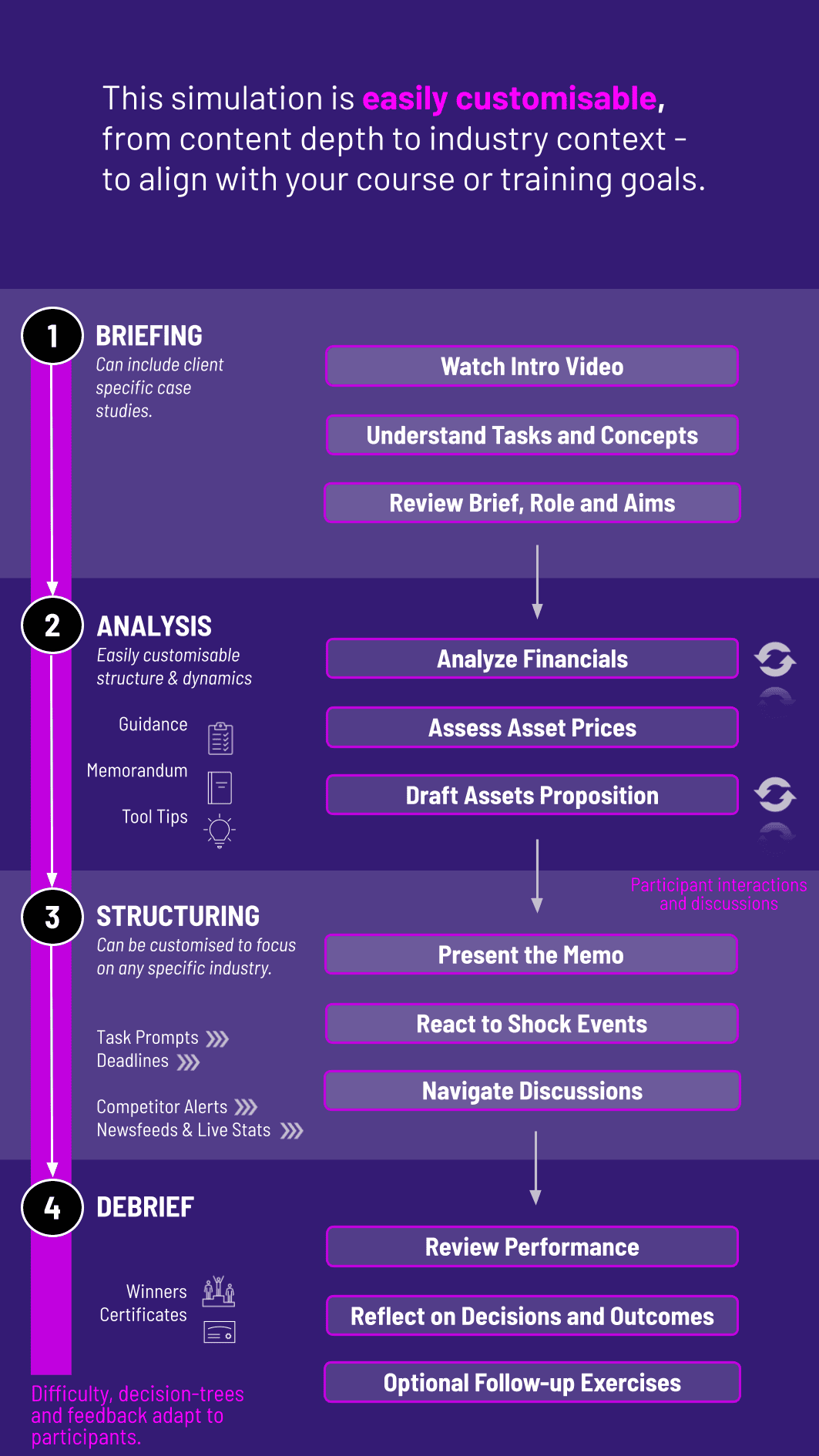

In the simulation, participants will:
Analyze the current balance sheet structure and identify key risk exposures.
Formulate a strategic ALM policy outlining risk appetite and targets.
Make quarterly tactical decisions on new business pricing, investment portfolios, and funding strategies.
Execute hedging transactions to mitigate identified interest rate and liquidity risks.
Respond to simulated market shocks, such as sudden rate hikes or deposit outflows.
Present their ALM strategy and performance results to the "board" or regulators.
Reflect on the trade-offs between profitability, risk, and regulatory constraints.

Explain the fundamental principles and importance of ALM for financial institutions.
Identify and quantify primary balance sheet risks, including interest rate and liquidity risk.
Develop and execute strategies to manage the duration gap and stabilize net interest income.
Design and justify a liquidity risk management framework that meets regulatory standards.
Make strategic balance sheet decisions that align with institutional risk appetite and capital goals.
Communicate complex ALM concepts and performance effectively to stakeholders.
Evaluate the impact of macroeconomic changes and market shocks on the financial institution's health.
Build confidence in making integrated, data-driven decisions under uncertainty.
1. Receive the Brief Participants are given control of a financial institution's balance sheet, along with its strategic goals, risk limits, and the current economic outlook.
** 2. Analyze the Position** They review detailed reports on gap analysis, liquidity metrics, and profitability to diagnose the starting position.
3. Make Strategic Decisions Each round, teams decide on loan growth targets, funding mix, investment securities, and hedging activities.
4. Collaborate and Negotiate In team settings, participants take on specific roles (Head of Treasury, Liquidity Manager, Risk Officer) to debate priorities.
5. Receive Market Feedback The simulator processes decisions, generates new economic data for the next period, and provides performance dashboards showing NII, EVE, liquidity ratios, and risk exposures.
6. Adapt and Present Teams adjust their strategy based on results and feedback, culminating in a final presentation of their ALM journey and outcomes.

Who is the ALM simulation designed for? It is ideal for MSc/MBA students specializing in finance or banking, professionals in corporate treasury, risk management, banking, and insurance, and anyone seeking to understand the core of financial institution management.
How long does the simulation take to complete? A standard delivery runs 4-6 hours but can be modularized into shorter sessions (e.g., 2-hour workshops) or extended for deeper analysis over multiple days.
Is this an individual or team-based activity? It is highly effective in both formats. The team-based version encourages collaboration and role-playing, mirroring real ALCO dynamics.
What kind of metrics and feedback does the simulator provide? Participants receive real-time dashboards with key performance indicators (KPIs) like Net Interest Income, Economic Value of Equity sensitivity, Liquidity Coverage Ratio, and duration gaps, allowing for immediate strategy evaluation.
Can the simulation scenario be customized for our institution? Yes. Core parameters, economic scenarios, regulatory frameworks, and the specific balance sheet composition can be tailored to reflect regional markets or specific institutional types.
How does this simulation help with career preparation? It provides direct, hands-on experience with the core analytical and strategic challenges faced by treasurers and risk managers, building highly valued skills for careers in banking, insurance, fintech, and corporate finance.
Do you provide support for instructors and facilitators? Absolutely. We offer comprehensive facilitator guides, onboarding sessions, and live support options to ensure a seamless implementation. The simulator also includes automated grading analytics.
Achievement of stable Net Interest Income, effective management of the duration gap, and maintenance of regulatory liquidity ratios.
The quality and justification of their ALM strategy and its adaptation to changing market conditions.
Proactive identification and mitigation of interest rate and liquidity risks.
Clarity and persuasiveness in presenting their strategy, results, and risk posture to the "ALCO" or board. In team settings, effective role-playing, debate, and consensus-building.

Join this 20-minute webinar, followed by a Q&A session, to immerse yourself in the simulation.
or
Book a 15-minute Zoom demo with one of our experts to explore how the simulation can benefit you.