This simulation is ideal for undergraduate and graduate finance students, MBA candidates, and professionals in fields like asset management, wealth management, and pension fund administration who seek to master portfolio construction.

Asset Allocation Simulation
In this Asset Allocation Simulation, participants step into the role of institutional portfolio managers, tasked with constructing and managing diversified investment portfolios across multiple asset classes.

Asset Allocation Simulation Overview
The Asset Allocation Simulation immerses participants in the core discipline of modern portfolio management. Acting as managers for a pension fund, endowment, or insurance company, they must navigate evolving economic cycles, shifting interest rates, and volatile market conditions.
Each decision-making round presents new macroeconomic data, geopolitical events, and client risk-profile changes. Participants analyze correlations between asset classes—such as equities, fixed income, real estate, and commodities—to build portfolios that can withstand market stress while meeting long-term return objectives. The simulation moves beyond theory, forcing trade-offs between strategic long-term targets and tactical short-term adjustments.
The simulation is perfectly suited for university finance programs, MBA courses, and professional training in asset management, providing an unmatched, hands-on understanding of how allocation decisions directly drive performance and client satisfaction.

Asset Allocation Simulation Concepts
Participants work through realistic scenarios, which can be customized to emphasize or exclude specific topics depending on the learning goals. This modular structure allows the simulation to be tailored to any type of session. Key concepts include:
- Modern Portfolio Theory and the Efficient Frontier
- Strategic vs. Tactical Asset Allocation
- Risk-Return Trade-off and Diversification Benefits
- Asset Class Characteristics
- Correlation Analysis and Portfolio Optimization
- Economic Cycle Analysis and Market Regime Detection
- Risk Metrics: Standard Deviation, Value at Risk, Sharpe Ratio
- Liability-Driven Investment Strategies
- ESG Integration in Portfolio Construction
- Performance Attribution and Benchmarking
- Client Profiling and Investment Policy Statement Adherence

Gameflow
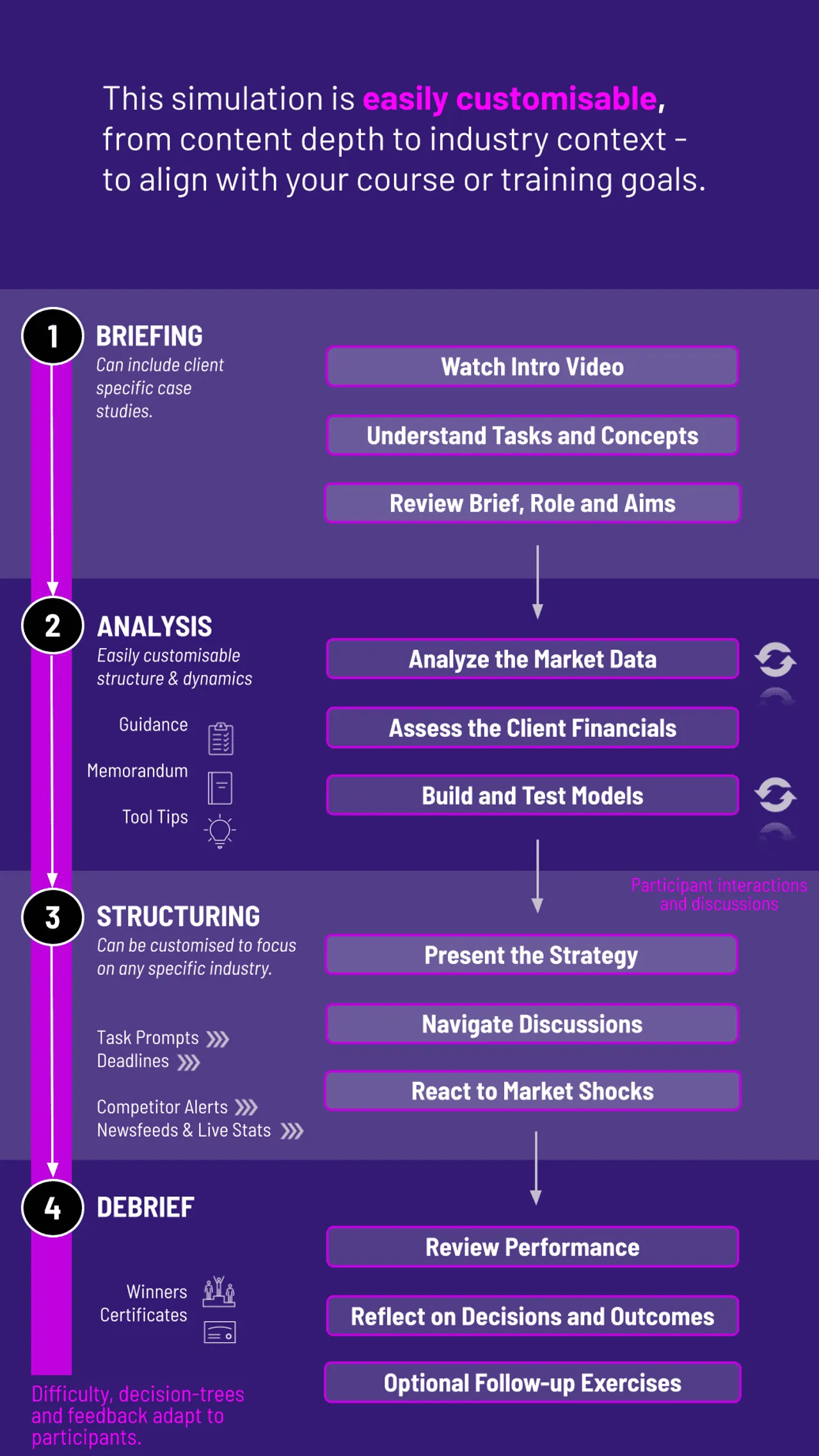

What Participants Do
In the simulation, participants will:
- Analyze client investment mandates, risk tolerance, and return objectives.
- Interpret macroeconomic forecasts and capital market assumptions.
- Construct an initial strategic asset allocation across global markets.
- Rebalance portfolios in response to simulated market movements and economic shocks.
- Decide when to make tactical shifts to capitalize on short-term opportunities.
- Present performance reviews and strategic rationale to a simulated investment committee.
- Reflect on the outcomes of their allocation choices and adjust their strategy.

Learning Objectives
By the end of the simulation, participants will be able to:
- Apply the core principles of Modern Portfolio Theory to build diversified portfolios.
- Distinguish between strategic, long-term allocation and tactical, short-term adjustments.
- Quantify and manage portfolio risk using key financial metrics.
- Respond strategically to changing economic indicators and market volatility.
- Align portfolio construction with specific client goals and investment constraints.
- Communicate allocation decisions and performance clearly to stakeholders.
- Evaluate the impact of alternative investments and ESG factors on portfolio outcomes.
- Develop confident, evidence-based decision-making under uncertainty.
How the Asset Allocation Simulation Works
This simulation can be run individually or in teams in academic or corporate contexts. Each cycle represents a stage of getting through a pressing financial situation.
1. Receive the Mandate Teams are assigned a client with a specific Investment Policy Statement outlining goals, constraints, and risk limits.
** 2. Market Analysis** Participants review a dashboard of economic data, asset class forecasts, and current market valuations.
3. Strategic Decision Teams establish their benchmark strategic allocation across major asset classes.
4. Execution and Rebalancing As each round progresses, new market data and events are introduced. Teams must decide whether to rebalance to their target or make tactical over/underweight decisions.
5. Collaboration and Negotiation Teams debate their views, often taking on roles like Chief Investment Officer, Risk Manager, or Equity Strategist.
6. Reporting Participants compile their performance, explain their decisions, and justify their strategy in a concise report or presentation.
7. Review and Iterate Detailed feedback is provided on portfolio returns, risk metrics, and IPS compliance, informing strategy for the next round.
Frequently Asked Questions
Assessment
Assessment of participant performance can be tailored according to the host institution’s objectives (business school, corporate training, assessment centre). Typical assessment criteria include:
- Risk-adjusted returns relative to a benchmark and peer groups.
- Effectiveness in controlling volatility and drawdowns during market stress.
- Success in staying within the client's IPS constraints and strategic goals.
- Quality of analysis and justification for allocation decisions.
- Clarity and persuasiveness in reporting to the investment committee.