This simulation is designed for MBA programs, Masters in Finance students, executive education cohorts, and corporate training programs at investment banks, hedge funds, and asset management firms seeking to deepen their team's practical skills.

Advanced Investment Theory Simulation
The Advanced Investment Theory simulation moves beyond theory, placing you in the role of a portfolio manager at a competitive investment fund, where you must apply advanced concepts to achieve superior risk-adjusted returns in a realistic market.

Advanced Investment Theory Simulation Overview
The Advanced Investment Theory Simulation is a cutting-edge experiential learning platform designed for MBA students, finance professionals, and advanced learners. Participants are thrust into a multi-period trading environment that mirrors the pressures and opportunities of real-world asset management.
They must construct, adjust, and optimize portfolios in response to live economic data releases, corporate news, shifting correlations, and volatile market conditions. The simulation emphasizes the practical application of sophisticated quantitative models and strategic decision-making, bridging the gap between academic theory and the nuanced judgment required in top-tier investment firms.
Success is measured not just by absolute return, but by performance metrics like the Sharpe ratio, alpha generation, and benchmark-relative results.

Advanced Investment Theory Simulation Concepts
Participants work through realistic scenarios, which can be customized to emphasize or exclude specific topics depending on the learning goals. This modular structure allows the simulation to be tailored to any type of session. Key concepts include:
- Modern Portfolio Theory and Efficient Frontier Optimization
- Capital Asset Pricing Model and Multi-Factor Models
- Alpha Generation and Active Portfolio Management
- Risk Decomposition: Systematic vs. Unsystematic Risk
- Performance Attribution Analysis
- Behavioral Finance Biases in Decision-Making
- Derivatives for Hedging and Speculation
- Fixed-Income Portfolio Strategies and Duration Management
- Alternative Asset Allocation

Gameflow

What Participants Do
In the simulation, participants will:
- Allocate capital across a diverse universe of equities, bonds, indices, ETFs, and derivatives.
- Conduct fundamental and quantitative analysis on simulated company financials and macroeconomic indicators.
- Formulate and execute a coherent investment philosophy and strategy statement.
- Rebalance portfolios dynamically in response to market shocks and new information.
- Use hedging strategies to manage portfolio risk exposures.
- Compete against peer-managed funds and market benchmarks.
- Present a final investment committee report justifying their strategy and performance.

Learning Objectives
By the end of the simulation, participants will be able to:
- Construct an optimal portfolio based on advanced risk-return optimization techniques.
- Evaluate asset performance using factor models and distinguish between skill-based alpha and market beta.
- Manage portfolio risk through diversification, hedging, and strategic asset allocation.
- Analyze the sources of portfolio return and underperformance through attribution analysis.
- Synthesize economic data and market news into actionable investment decisions.
- Defend investment choices using the rigorous language and frameworks of professional asset management.
How the Advanced Investment Theory Simulation Works
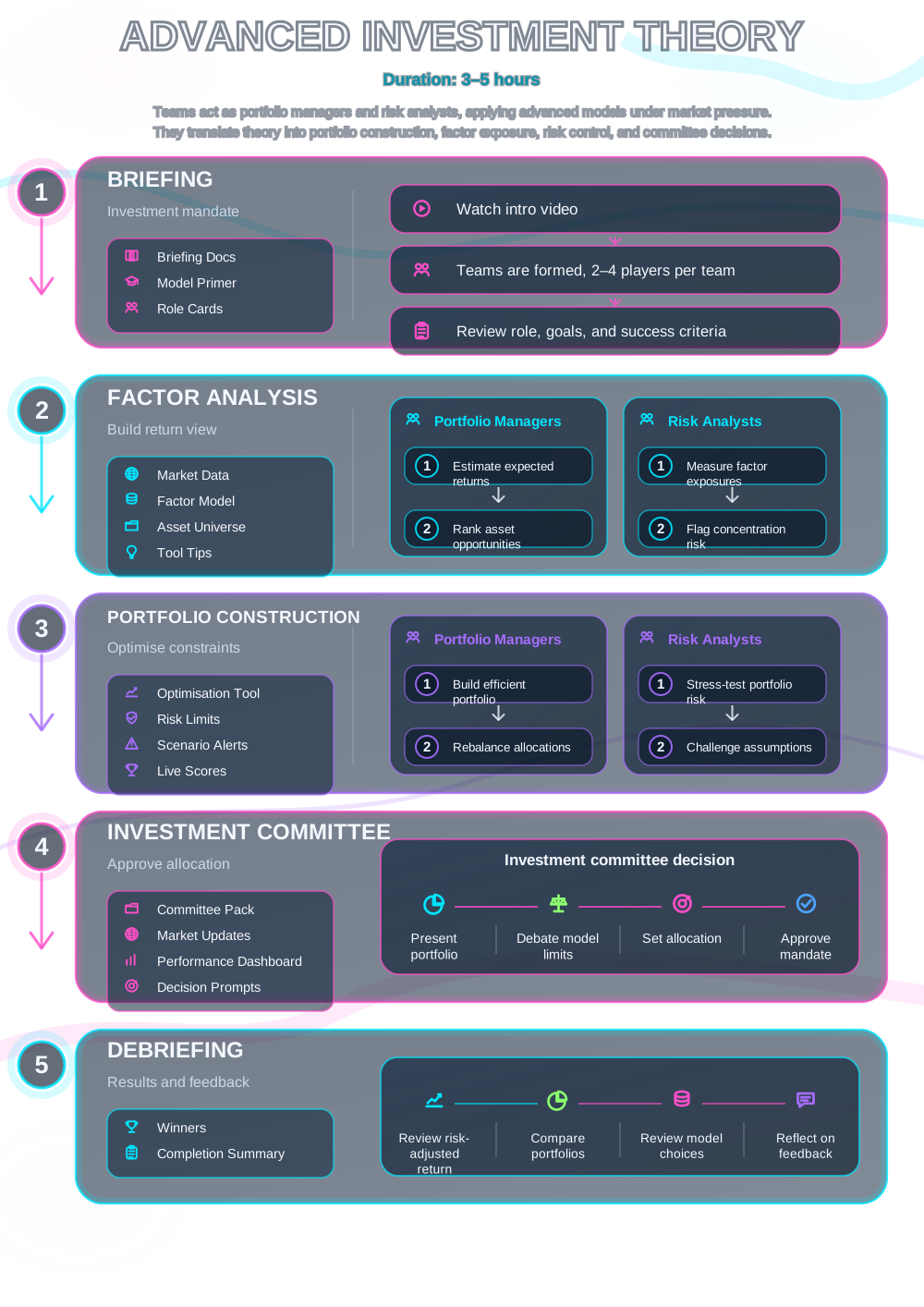
This simulation can be run individually or in teams in academic or corporate contexts. Each cycle represents a stage of getting through a pressing financial situation.
1. Setup and Strategy Participants are assigned capital and access the simulation dashboard. They research the initial economic climate and asset classes before defining their core strategy.
2. Trading Periods The simulation progresses through several rounds. Each round features new market data, earnings reports, and potential "market shock" events.
3. Decision-Making Participants analyze the new information, adjust their forecasts, and execute trades. They can issue orders for long/short positions, options, and other derivatives.
4. Feedback and Analysis After each round, detailed performance reports are generated, showing returns, risk metrics, sector exposures, and a comparison to benchmarks and peers.
** 5. Debrief and Presentation** The simulation concludes with an in-depth debriefing session. Teams or individuals prepare a final analysis linking their decisions to theoretical concepts and their ultimate performance outcome.
Frequently Asked Questions
Assessment
Assessment of participant performance can be tailored according to the host institution’s objectives (business school, corporate training, assessment centre). Typical assessment criteria include:
- Quantitative Performance is measured by risk-adjusted metrics, consistency of returns, and performance versus a stated benchmark.
- Quality of the initial investment policy statement and the rationale provided for portfolio adjustments in each period, linking actions to theoretical concepts.
- Effective use of diversification, hedging, and adherence to stated risk parameters. Evaluation of drawdown control and volatility management.
- Clarity, depth of insight, and honesty in the final performance attribution analysis, including a discussion of what worked, what didn’t, and the theoretical lessons learned.