Intense, real-world, memorable - gamified simulation training
Intense, real-world, memorable - gamified simulation training

In the Accruals Simulation, participants navigate the complex world of accrual accounting. They will make critical decisions directly impacting financial statements, corporate valuation, and stakeholder perception in a dynamic, competitive environment.


Accrual vs. Cash Accounting
Revenue Recognition
Matching Principle
Adjusting Journal Entries
Impact on Financial Statements
Quality of Earnings
Working Capital Management
Financial Analysis and Ratios
Tax Implications
Stakeholder Communication
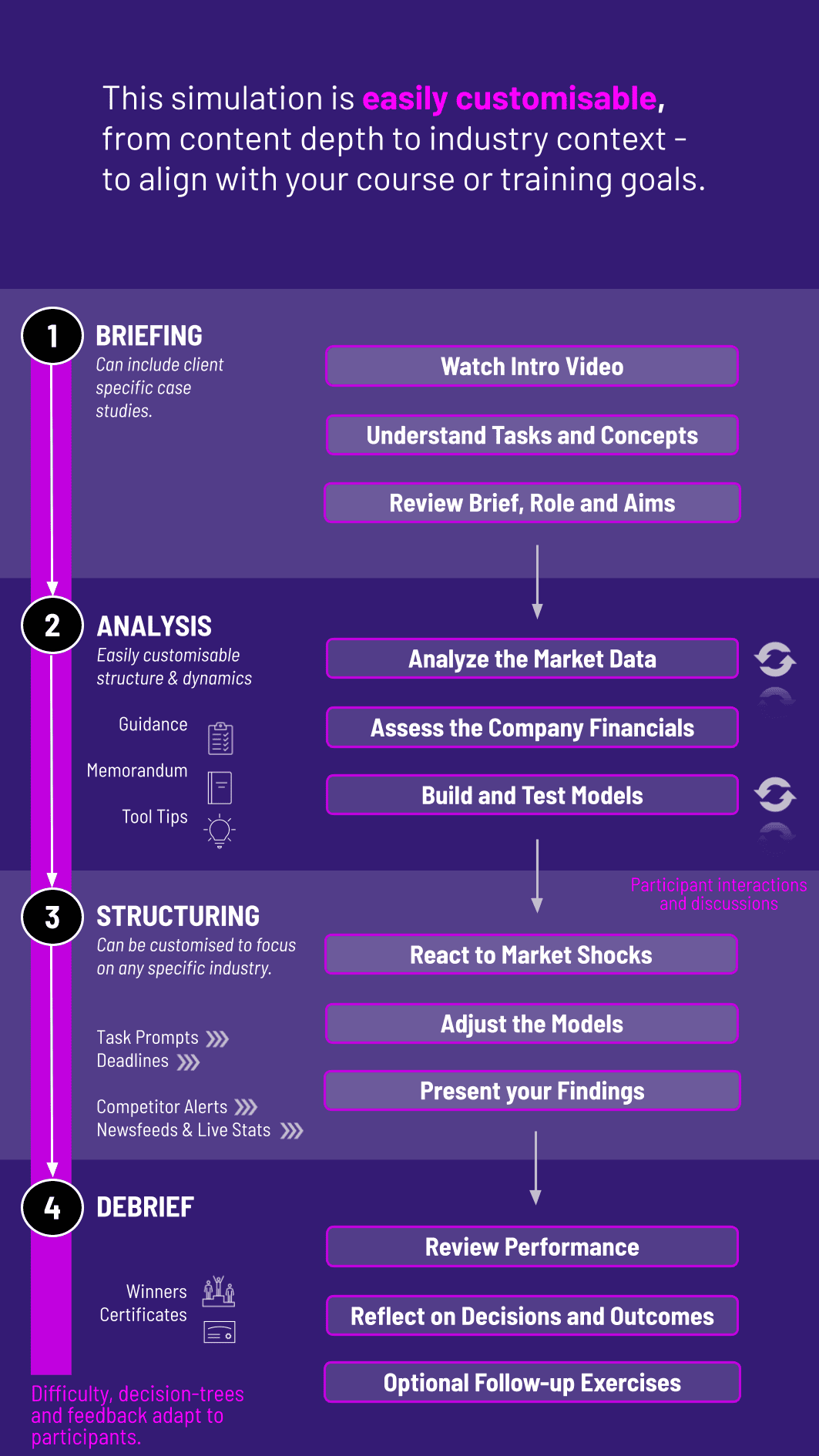

In the simulation, participants will:
Analyze business transactions to determine the correct accrual accounting treatment.
Record adjusting journal entries at the end of accounting periods.
Manage working capital by setting policies for customer credit and supplier payments.
Make estimates for critical items like bad debt expense and warranty liabilities.
Prepare and analyze key financial statements under the accrual basis.
Calculate and interpret financial ratios derived from accrual-based reports.
Present financial results and justify accrual judgments to simulated "board members" or "investors."
Compete with other teams to achieve the most accurate, compliant, and strategically sound financial reporting.

Explain the fundamental principles and necessity of accrual accounting in financial reporting.
Apply the revenue recognition and matching principles to a variety of business scenarios.
Prepare accurate adjusting journal entries for accruals, deferrals, and estimates.
Analyze the impact of different accrual judgments on all primary financial statements and key performance metrics.
Evaluate the quality of a company's earnings by examining its accrual components.
Communicate the difference between cash flow and accrual-based profit to non-financial stakeholders.
Demonstrate how accrual decisions directly affect a company's valuation and perceived financial health.
Develop professional judgment in making estimates and accounting policy choices within a framework of ethics and compliance.
1. Receive the Business Scenario Teams are given a company profile and a stream of economic events (sales, purchases, expenses) for the period.
** 2. Analyze Transactions and Make Decisions** Participants review contracts and transactions to determine which require accrual entries. They make policy estimates and decide on the timing of expense recognition.
3. Record Entries and Generate Statements Teams input their accrual decisions into the simulation platform, which automatically generates the resulting Income Statement, Balance Sheet, and Cash Flow Statement.
4. Review Competitive and Market Feedback The platform provides instant feedback on their choices, showing their financial metrics compared to competitors and highlighting any compliance flags or analytical red flags.
5. Present and Justify In advanced rounds, teams may be required to present their period-end results, defending their accrual judgments and estimates.
6. Debrief and Strategize Between rounds, teams review their performance, analyze how their accruals affected their stock price (within the sim), and adjust their strategy for the next period based on new business challenges.

Who is the Accruals Simulation designed for? It is perfect for undergraduate and graduate students in accounting, finance, and business administration, as well as professionals in corporate finance, accounting, or auditing roles seeking to deepen their practical application of accrual concepts.
Do participants need prior accounting experience? A basic understanding of fundamental accounting terms (debits/credits, the accounting equation) is helpful but not mandatory. The simulation includes instructional videos and guided tutorials to bring all participants to a common starting point.
How long does the simulation take to complete? A standard experience runs for 2 to 3 hours, but it can be segmented into shorter modules or expanded for more in-depth competition.
Is this an individual or team-based activity? It is designed for small teams (3-5 participants) to encourage discussion and collaborative decision-making, mirroring real-world finance department dynamics, but can also be configured for individual play.
What specific accounting standards does it cover? The simulation focuses on the universal principles of accrual accounting (revenue recognition, matching). It can be contextualized within major frameworks like IFRS or U.S. GAAP based on the instructor's preference.
Can the simulation scenarios be customized? Yes. Instructors can adjust the complexity of transactions, the industry setting, and specific learning modules to fit their curriculum, whether for an introductory financial accounting course or an advanced financial statement analysis seminar.
How is performance measured and scored? Performance is multi-faceted: scoring is based on the accuracy and compliance of journal entries, the strategic impact of accrual choices on company valuation and ratios, and the clarity of communication in presenting financial results.
What tools or platforms are required? The simulation is a cloud-based application accessible via standard web browsers on laptops, tablets, or desktops. No special software installation is required.
Correct application of accrual principles and preparation of adjusting entries.
Quality of financial statement outcomes and ratio analysis.
The business rationale and ethical considerations behind estimated choices and accounting policies.
Effectiveness in presenting and justifying financial results derived from accrual accounting.
Ability to work as a team and refine strategies based on feedback across multiple periods.

Join this 20-minute webinar, followed by a Q&A session, to immerse yourself in the simulation.
or
Book a 15-minute Zoom demo with one of our experts to explore how the simulation can benefit you.